Review by Stuart Miller.
In Mfoniso Udofia’s new play creation stories and all the important importants, which opened tonight at the Claire Tow Theatre at Lincoln Center, an unnamed “Grown Woman” wakes from a surreal dream about spirit forces and the night sky. She turns to Alexa and Siri to provide alarms and playlists to keep her motivated and on task as she struggles with the morning. It’s not just a matter of getting showered, dressed and fed, it’s about giving herself injections and it’s about carving out time to try and write, to rediscover her creative muse, which is deeply blocked.
The “Grown Woman” (Abigail C. Onwunali) talks to herself, pushing, prodding, urging herself forward, but she pulses with a frantic energy, which careens from fear to hope. In Mfoniso Udofia’s “creation stories and all the important importance,” the need to create is not just about writing but also about creating new life. The protagonist has been trying through endless cycles of IVF to get pregnant. Well, not endless– this is the last one, and she’ll find out today if she can finally have a baby or lose that dream forever.
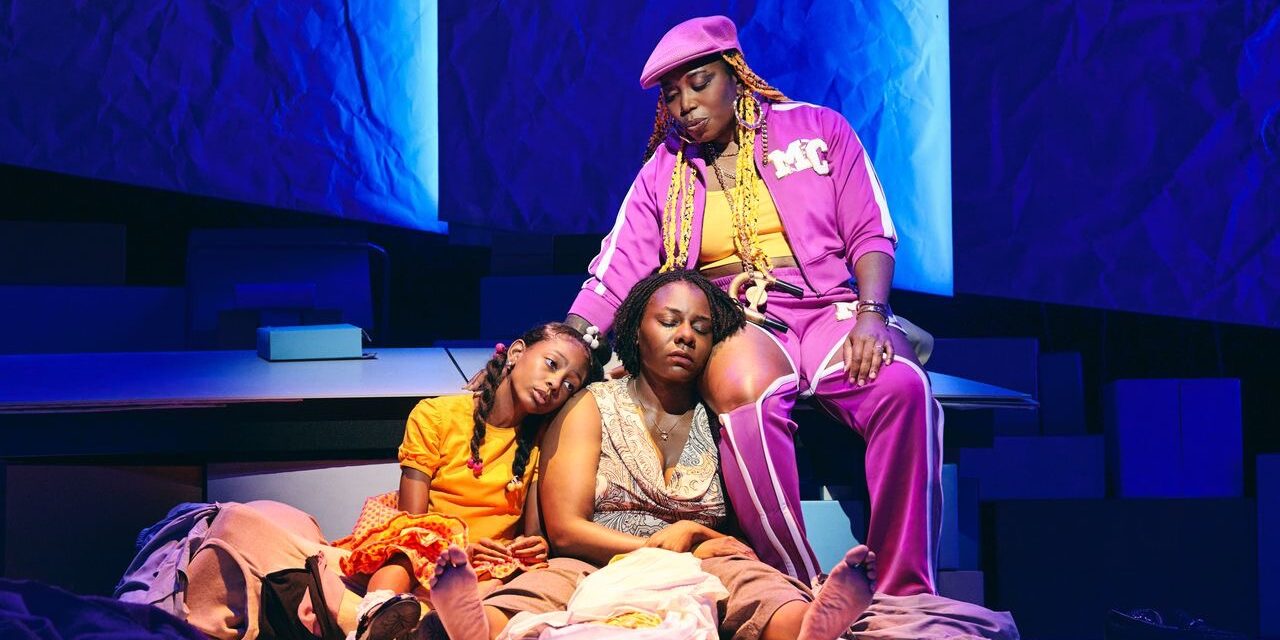
She is not alone, however. She’s accompanied through her day by the nine-year-old version of herself (Savannah Commodore), brimming with imagination and optimism, who talks to a horse friend named Mr. Cornell (Donetta Lavinia Grays). But she can’t see or hear this younger self for most of the play, she’s stuck in her stress-filled present– going to the doctor, dealing with a call from her mother and teaching a college course on the well-made play… and how to break all those rules and create something magical. (She also gets lectured by the department chair on dropping the rule-breaking playwright from the syllabus.)
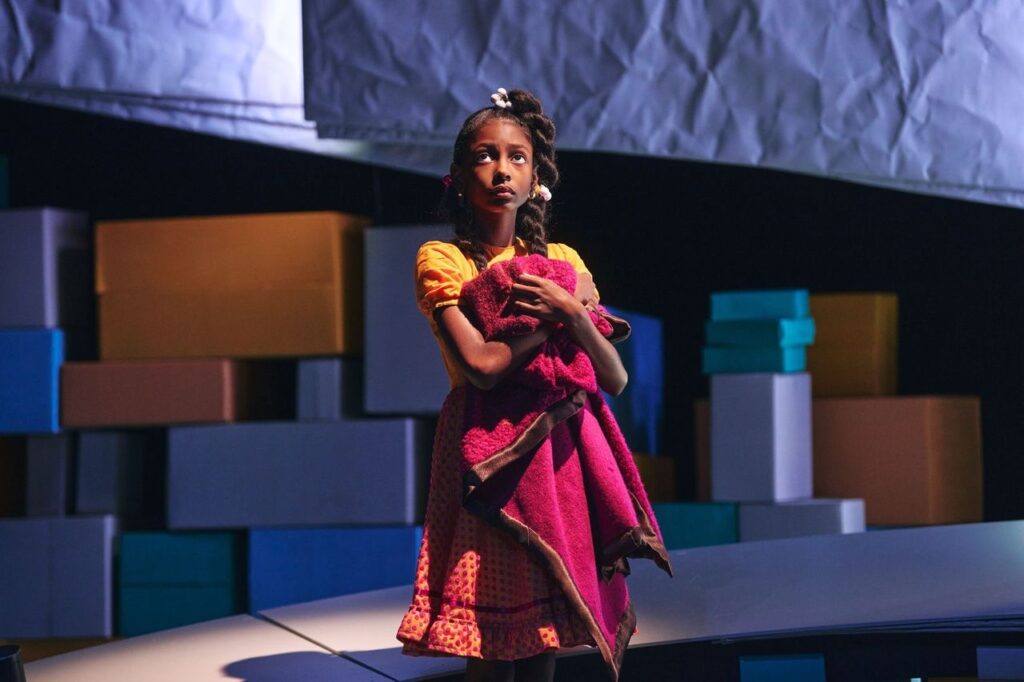
There’s a meta-element to the theater class: Udofia has written a play that de-emphasizes plot and action and classical structure in favor of a character study, and it does a good job of explaining her goals and approach even if it may be too on the nose.
The play, however, does build to a dramatic climax, which finally brings together the Grown Woman and her younger self, as the Woman finally sees that her life as she constructed it—setting her sights on one star in the cosmos and hurtling toward it with blinders on—is untenable. She realizes that she has closed herself off to other paths, to other stars, and that she can rediscover her sense of wonder and remember what it’s like to be loved and cared for. That’s an elliptical way of describing a magical, mystical scene that reinforces the idea that this is a fairy tale for grownups more than a traditional play.
But there’s a problem with fairy tales, which is that they can seem at a slight remove from reality. Udofia has spoken of enduring her own IVF experience and so this is a play with personal resonance. Yet, it also feels abstract much of the time.
The “Grown Woman” references Samuel Beckett at one point and there’s a Beckett-ian frustration and futility we feel while watching her push a cart through Costco and around the city, talking herself into going on. But Beckett often aims for the head, not the heart and this play seems to want both, which puts it in conflict with itself. The minimalist and abstract set is visually arresting but takes us away from the woman’s very real pain. What keeps it grounded and intimate are the performances, especially the fully present, deeply emotional Onwunali, whose life and hormones are tossing her to and fro.
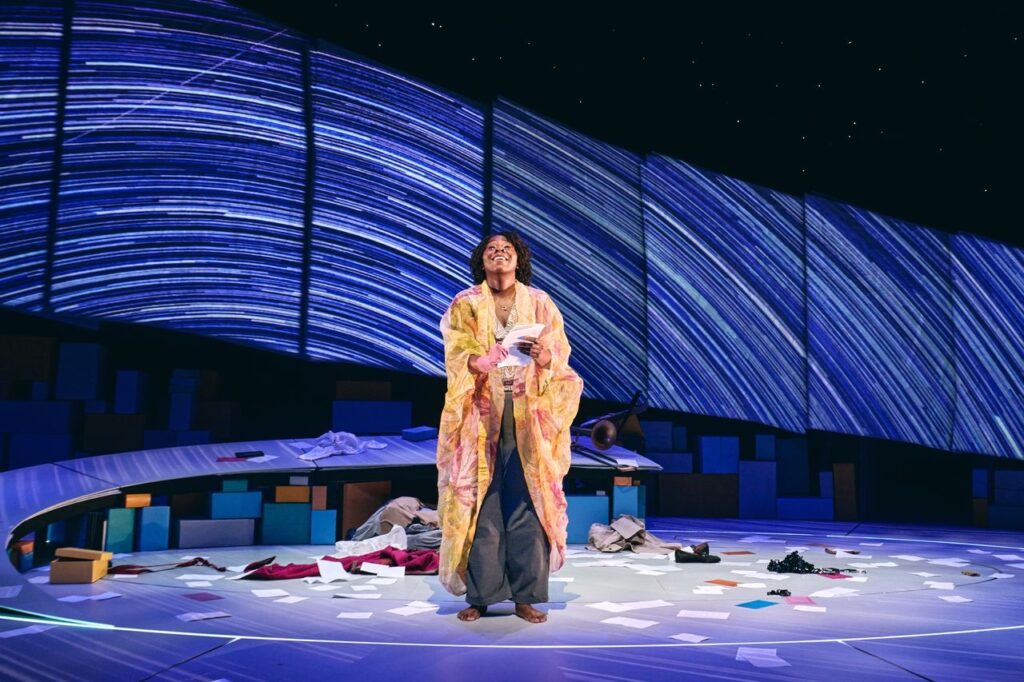
I think the problem is that until the very end, Onwunali is talking only to herself. Her conversations with the nurse, doctor, department chair and her mother are one-sided, so these people aren’t real. That’s especially a problem with the “Grown Woman’s” mother, because something is missing early in the dynamic between the two women that undercuts the impact of a pivotal conversation they have near the end. If the mother had been an onstage character, interacting with her daughter, the play might have hit harder. The story Udofia has written is emotionally potent—when I described it afterward to my wife, a psychologist, she said the ideas and themes would powerfully resonate with many of her clients—but it is not fully realized in its current form, despite the imaginative way in which it is told.
creation stories and all the important importants is playing at LCT3 at Lincoln Center through November 1. It runs 95 minutes. For ticket information, please click here.
Photos by Valerie Terranova.
Headline photo: Savannah Commodore, Donnetta Lavinia Grays, and Abigail C. Onwunali.