By Alix Cohen
Written late in Shakespeare’s life, The Winter’s Tale is thought to have been inspired by Robert Greene’s 1588 prose romance Pandosto (also called The Triumph of Time). The basic plot—an insanely jealous king, a falsely accused queen, an abandoned child who grows up elsewhere, and a reunion years later—comes directly from Greene.
The Bard enriched Greene’s conventional piece with the passing of sixteen years, contrast between formal Sicilia and pastoral Bohemia, comic shepherd scenes, and an extraordinary final reunion with Hermione.
It’s a pleasure to see Shakespeare performed without novelty changes perpetrated upon us of late. Almost this entire company has skill with verbal resonance and emotional immediacy necessary to best showcase the iconic playwright. Characterization is adroit.
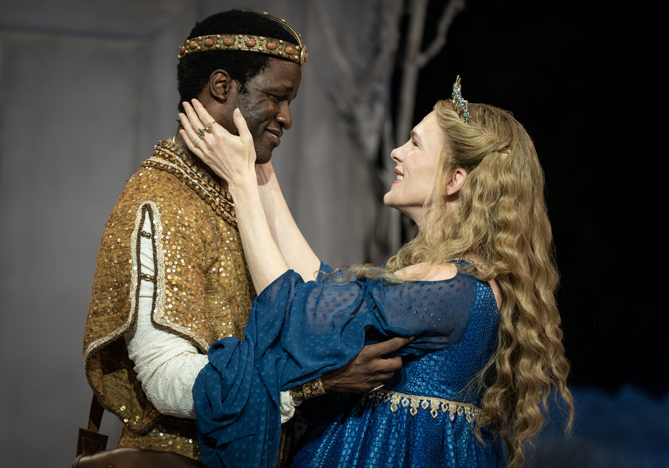
Polixenes (Gilbert Owuor) & Hermione (Lily Rabe)
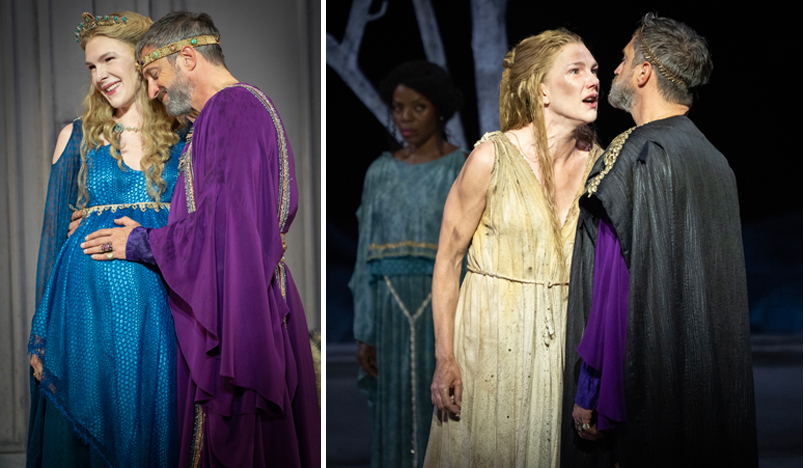
King Leontes of Sicilia (Raúl Esparza) and his pregnant wife Hermione (Lily Rabe) have been, for nine months, convivially hosting his childhood friend Polixenes of Bohemia. (Gilbert Owuor) Leontes encourages the queen to convince Polixenes to stay a bit longer. She naturally acquiesces.
In an explosive fit of what- irrational, prenatal chemistry? Leontes accuses them of infidelity and Hermione of carrying the other man’s baby. He conscripts loyal servant Camillo (Teagle F. Bougere) to poison Polixenes. Instead, Camillo and the intended victim flee to Bohemia.
Hermione is denied her young son Maxmillius (Matthew Eby) and imprisoned. She births a girl child carried to the king by dear friend Paulina (Marsha Stephanie Blake.) Leontes won’t even look. Paulina’s husband, Antigonus (Steven Skybell) is commanded to take the infant and abandon her far away.

Michael Khalid Karadsheh (young shepherd) & Chuck Cooper (old shepherd)
In quick succession, Maxmillius dies, Hermione is carried off and reported dead, two servants sent to Delphi for the gods’ truth reveal Leontes to be wrong on every count. The king collapses in despair.
Just as in Greene, the child, Perdita (Isabela Ferrer) grows up in the home of an old shepherd (Chuck Cooper) and his son (Michael Khalid Karadsheh) – in Bohemia. She and Polixenes’ heir Florizel (Daniel Kyri) are secretly in love. His father would not approve.
Separate situations overlap and radically affect one another. There’s a goat herd festival that elicits signature-to-the bard dancing, comic relief, hidden identities, flight by sea, revelation and reconciliation. A surprising, at-the-face-of-it positive ending can’t ameliorate Leontes’ guilt.
The three hour piece could successfully be cut by 15 minutes- of Autolycus, a supposedly droll rogue allotted way too much stage time. Steven Skybell, brilliant as Tevye in both the Yiddish Fiddler on the Roof and the ill conceived resurrection of Cabaret, here unaccountably overacts.
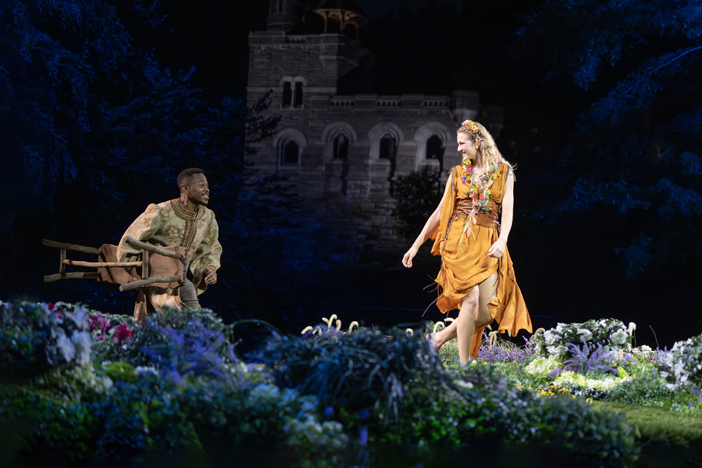
Daniel Kyri (Florizel) & Isabela Ferrer (Perdita)
The other weak link is Isabela Ferrer (Perdita) who simply doesn’t have the chops for Shakespeare, reducing dramatic affect with every stiff, insubstantial appearance.
Raúl Esparza, Lily Rabe, and Marsha Stephanie Blake are stand-outs. Soliloquies by Leontes and Hermione dazzle. Paulina exudes grace and restrained fury. Chuck Cooper’s old shepherd is appealingly solid; Teagle F. Bougere’s Camilo, sympathetic.
Director Daniel Sullivan continues a career of delivering splendid theater. (‘Caveats above) Staging makes narrative sense. Pacing is excellent. Royals are patrician. Human fallibility and impotence of characters is potent. Cadence of speech arrives natural and comprehensible.
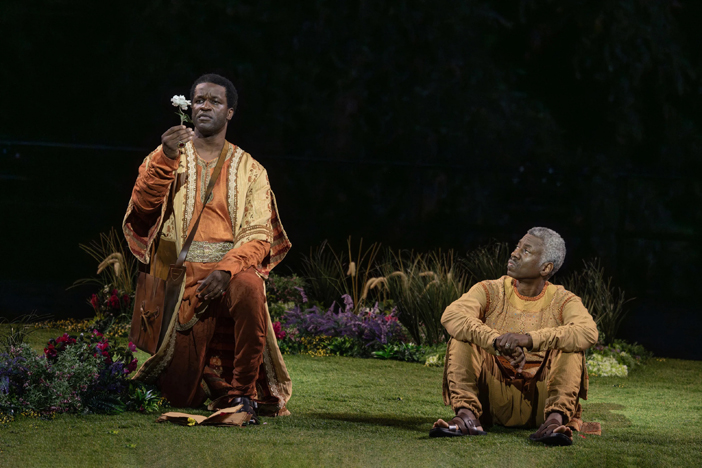
Gilbert Owuor (Polixenes) & Teage F. Bougere (Camilo)
Incidental music (Tom Kitt) is evocative, though song lyrics emerge awkward. Strolling musician Peter Douskalis skillfully adds strains of atmospheric laouto – a traditional Greek, long-necked string instrument. Mimi Lieber’s choreography is sprightly.
Scenic design (Maruti Evens) is, except for a flatbed of spring flowers, unoriginal and too spare. Having similar reaction to the set of the Public Theater’s Romeo and Juliet, one can’t help but wonder whether visuals are partially a budgetary issue.
Costumes (Linda Cho) are attractive if not distinctive.
The play “is the thing” and this particular production is well worth seeing.
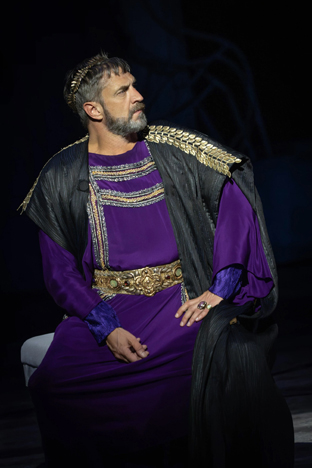
Raúl Esparza (King Leontes of Sicilia )
“Winter’s tale” was a phrase for an old-fashioned, possibly implausible story told to pass the time during winter.
Photos by Joan Marcus
The Public Theater presents
The Winter’s Tale by William Shakespeare
Directed by Daniel Sullivan
The Delacorte Theater in Central Park
Through August 23, 2026
Tickets:
Digital Lottery: Enter the daily digital lottery via the TodayTix App for a chance to claim last-minute seats.
In-Person Lines: Free ticket vouchers are distributed at 12:00 PM (Noon) on performance days at the Delacorte Theater in Central Park. You should plan to arrive early to wait in line.
Borough Distribution: Vouchers are given out at pop-up locations across all five NYC boroughs on specific dates.