By Alix Cohen
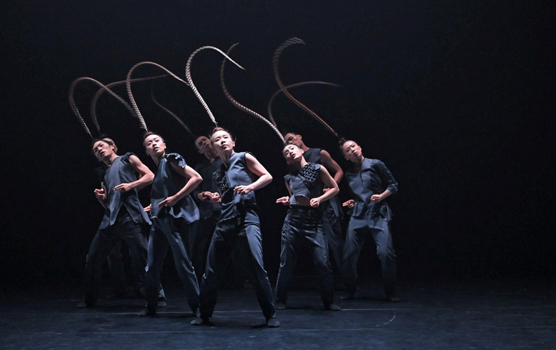
The 4’ pheasant feather sprouting straight up from a dancer’s head sways gently as he begins to move. (All wear topknots and dark costumes. From a distance, it’s impossible to tell whether anyone is man or woman.) The company erratically circles.
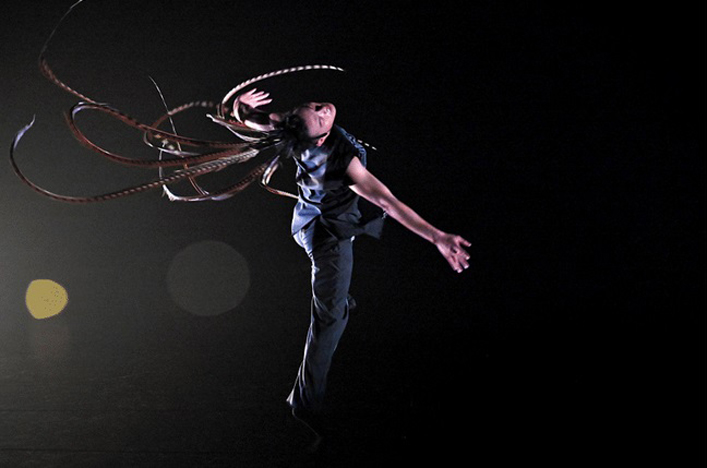
Feathers are plucked out. Held like scribe quills, they’re used to write in the air, then on the body of a figure who expresses wide-mouthed pain. The dancer is whipped with them. Dozens of feathers are thrown like spears, then laid across open arms. Flat palms facing us, fingers splayed, the flock configures large, fluttering wings.
An outsider undulates, tugged left and right, then encircled. Two central faces are spot- lit open mouthed. Are they making silent squawks? Is it communication or horror? The contained figure collapses. Others pitch on top one another. Reaching, they uncoil and rise dreamlike.
The covey is not welcoming. When outsiders find each other, pas de deux emerge with dancers like separate magnetic poles, stretching towards, but repelled. Small steps traverse distance.
In Chinese opera, feathers, or lingzi, are traditionally used to indicate warriors.These sweep, circle, flick, quiver, whack and amplify creating unique spacial and emotional aspects to choreography. At one point a feather is used to slice a neck, at others, they stroke.
Movement rooted in Tai Chi pairs short, sharp, kinetic jerking = power, with slow, flowing bridges = delicacy. The former may also be influenced by choreographer Lai Hung-Chung’s regard for hip-hop street dancing.
Flexibility and precision are paramount. Dancers frequently bend all the way back like contortionists. Limbs are most often bent.Floor work is imaginative. The piece explores tension between freedom and restraint, inclusion and exile.
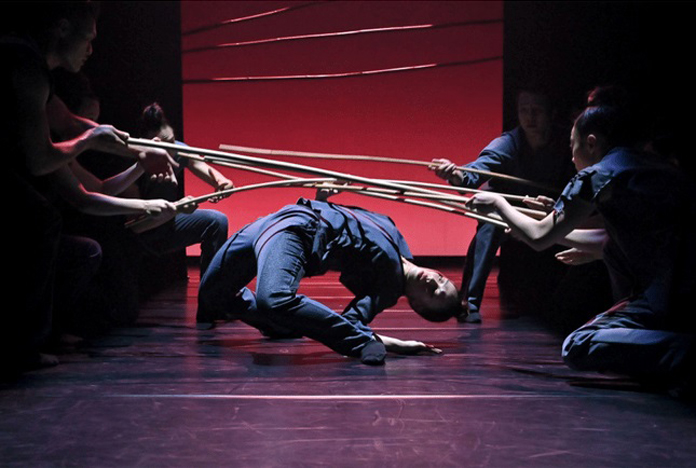
There’s no credit for what seem to be scenic decisions. Parting a back curtain to leave a bright red, vertical rectangle exposes what looks like horizontal wires. Imagery is terrific, especially when these fall at once with a clatter, revealing themselves to be stiff.
Dancers battle with the staffs and create a series shifting, of maze-like cages around a struggling outsider. They’re creatively employed to restrain, lift, or support,
A score of traditional Chinese classical music melded with electronics (no discernible melody, but not unduly abrasive) features synthesizer, sampled percussion, zithers, fiddles, and bamboo flutes. It’s otherworldly rather than industrial. Inserting some melody would, however, be embraced.
Costumes by Summer Lin can only truly be seen at the curtain call. What looks uniform on a darkened stage is actually subtly different versions of tucks and drapes. They’re handsome.
Lighting Designer Sung Yung-Hung creates vignettes with varied fades and bursts, shaped spots, and air-brushed edges. Moments when dancers appear as black silhouettes are striking. A red-lit scrim is used to stunning effect.
The piece is unique, riveting.
Photos by Liu Ren-Hau
Taipei Cultural Center in New York & Center Ring Theatrical preset
Hung Dance – Birdy
Debut at The American Dance Festival 2024
Lai Hung-Chung – Artistic Director/Choreographer
Hsu Chia-Wei – Composer
NYU Skirball : https://nyuskirball.org/
Hung Dance : https://www.hungdance.com/product.php?lang=en&tb=2&cid=68