By Alix Cohen
Were committee creations not so likely to manifest a camel instead of a horse, Ogden Nash, Samuel Beckett, Eugène Ionesco, Tom Stoppard, and Tom Lehrer might’ve been the playful worksmiths- whoops- wordsmiths responsible for
A Play On Words.
Brian Dykstra has always been masterful with text. In this play, verbal pyrotechnics are not just the method, but the meat. Find political, social and intellectual satire in Lewis Carroll’s Alice books or read them as nonsense fiction. Either take can be extremely entertaining.
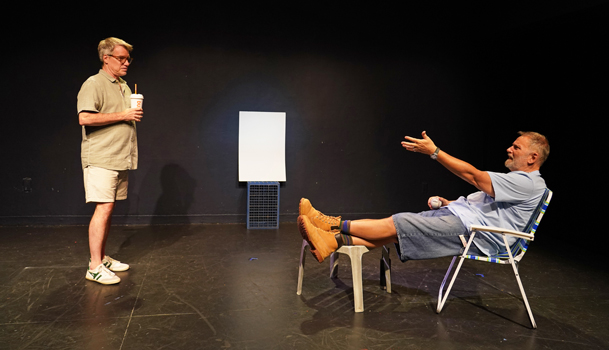
Max (Brian Dykstra) is sitting in a beach chair contemplating a big, white, blank posterboard when his longtime friend Rusty (Mark Boyett) comes along. An innocent greeting – “Hey…what’s the story?” -sets off parrying about the meaning and intention of words. “What’s the story,” is like saying, “hey,” Max begins.
That the battle over entomology – whoops, etymology, employs common, unpretentious idioms is testimony to the playwright’s skill with communication. It even comes up in the piece. Frustrated, Rusty theorizes that language isn’t communication.
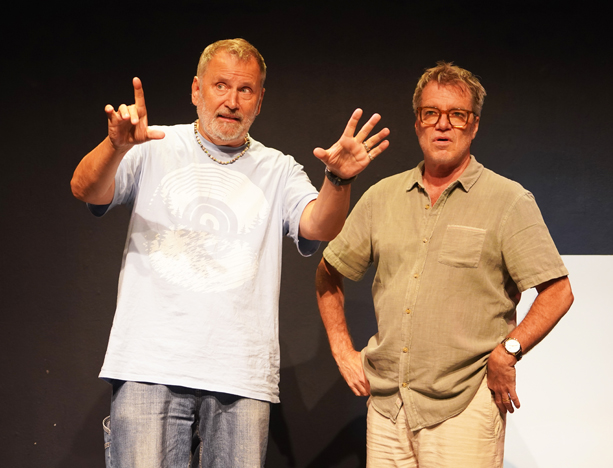
Brian Dykstra (Max) & Mark Boyett (Rusty)
“You’re using the language you think doesn’t communicate, in order to communicate that language doesn’t communicate. Clearly, at least in this case, language is communication,” Max says.Rusty observes they’ve lost the thread of ‘the actual topic.’ (It’s much like Abbot & Costello’s Who’s On First?)
Said topic is what Max is doing with the posterboard. It seems the town is hosting simultaneous rallies of Conservatives and Liberals within sight of one another. Max intends to write something incendiary on either side of the board in order to inflame both factions.
Rusty calls it “both communication, and a lack of same….Because we don’t need to be truthful, just make an authoritative statement people will react to.”
Suggestions for the sign are marvelous. Dykstra always manages to insert politics into his work. As the play proceeds, Rusty, who appeared to be second banana, shows his mental acuity. In some ways, he’s a worthy opponent, in others, however, a pawn.
Conversation arrives with the rhythm of a vaudeville routine and the intellectual edge of an absurdist debate. Single words fly back and forth more frequently than speeches.
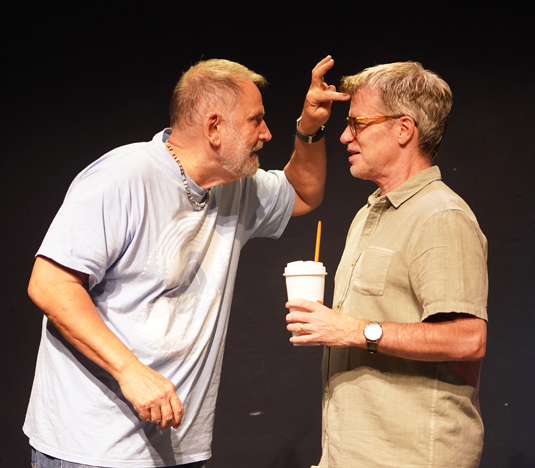
Brian Dykstra (Max) & Mark Boyett (Rusty)
Director Margarett Perry handles comic timing with virtuoso nuance. Everything lands on the right beat with just enough space for both characters and audience to understand and react. Variation of organic gestures is impressive, vocal cadence pitch perfect.
Both Mark Boyett and Brian Dykstra are terrific actors. Were they not well matched, the play would hobble. Max and Rusty emerge subtly different personalities rather than two aspects of the same thinking which, by nature of the play, might easily occur. Focus is absolute; facial expressions priceless.
A Play On Words explores the pleasure and peril of trying to use words to make sense of the world. It’s a high-wire act of wit, wordplay, and comic combat, asking whether language brings us closer to understanding—or merely gives us new ways to confuse, manipulate, and argue. It’s FUN!
Photos by Carol Rosegg
Twilight Theatre Co. presents
A Play On Words by Brian Dykstra
Directed by Margarett Perry
Through July 16, 2026
59E59 Theaters https://www.59e59.org/