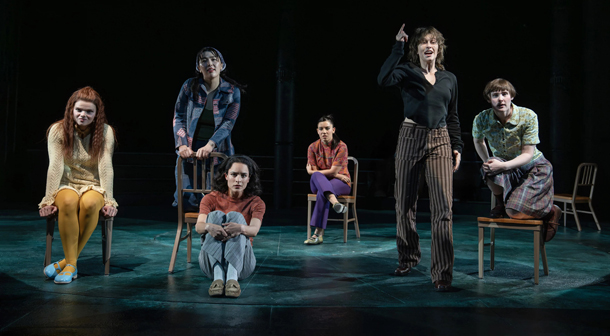
18 year-old Susanna (Juliana Canfield) downed 50 aspirin “because it was the next best thing to suicide.” Revived, she signed herself into McLean Hospital for psychiatric care.
This is not a Snake Pit story. (That 1948 film was based on horrors experienced at a New York State hospital.) McLean’s is well run and posh (alumni includes Ray Charles and James Taylor.) Neither is it a pity party or viewed through rose colored glasses.
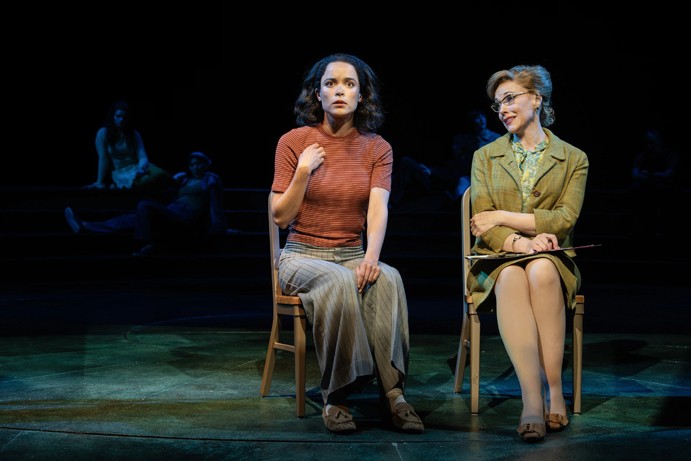
Juliana Canfield (Susanna) & Emily Skinner (Dr. Wick)
Susanna’s radical action followed an affair with her considerably older teacher. We’re shown a glimpse of his grooming her. The young woman is sent to a therapist who spends all of fifteen minutes to diagnose “compulsive and promiscuous” behavior. “Gimme fifteen minutes, that’s all it takes,” he sings.
Hundreds of thousands of U.S. teenage girls receive inpatient psychiatric treatment each year. The play as the book not only gives us a look inside but addresses authority, control and deciding whether hospitalization is necessary. In 1967, at 18, the author was legally considered an adult. Susanna can’t, however, figure out what’s wrong with her- “I was just so tired.” Others’ issues seem obvious.
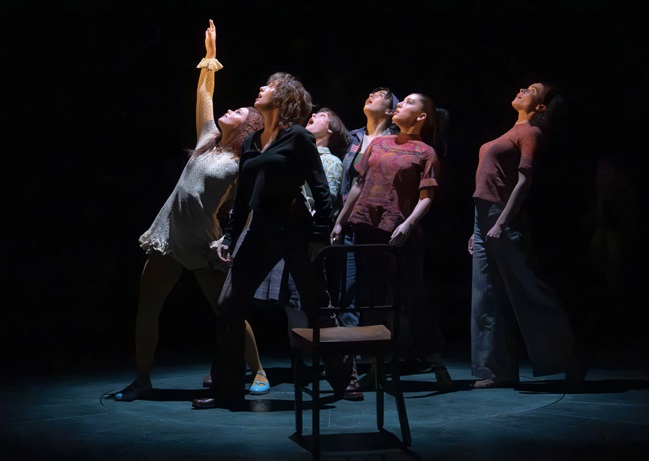
Katherine Reis (Daisy) King Princess (Lisa), Sally Shaw (Polly), Mia Pak (Grance) Gabi Campo (Tori)
Juliana Canfield (Susanna)
Also at the facility are:
Lisa (King Princess) is a manipulative punk with a 70s shag haircut (the only bad wig) and a penchant for breaking rules. Unlike the rich girls, her parents mortgaged the house to have her hospitalized. “What have we here? A sweet little rosebud,” she comments provocatively, proudly warning Susanna she’s psychopath.
Grace (Mia Pak) repeatedly corrects Lisa’s romanticized self-assessment: “sociopath.” She herself was “swallowed by a black cloud.” Susanna and Grace bond with a lilting song about writers Robert Lowell and Sylvia Plath, both of whom were incarcerated at McLean’s, though at different times. The sweet tune might evoke Winnie the Pooh rather than two unstable patients.
Music and lyrics are appealing, understated, and fairly uncompromising. Voices are all excellent, harmony very fine. Several actors effectively double on musical instruments.
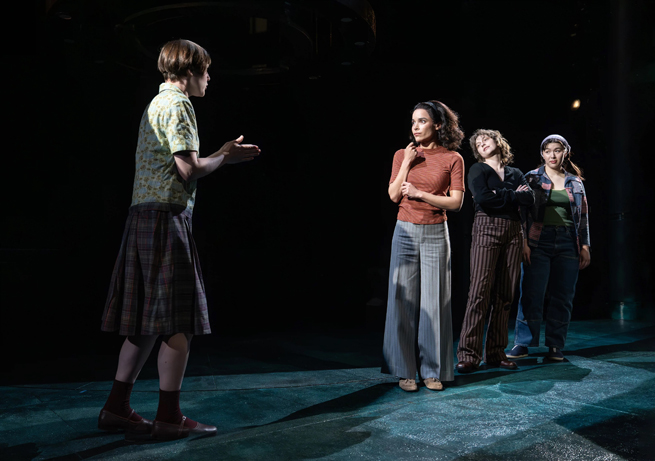
Sally Shaw (Polly), Juliana Caulfield (Susanna), King Princess (Lisa), Mia Pak (Grace)
Polly (Sally Shaw) initially seems “normal” to Susanna. “What day is it? Tuesday…it’s GREEN BEANS! What a good day to arrive!” Face and neck burns are the result of setting herself on fire. “When I lit the match, I felt in control of my life.”
Tori (Gabi Campo) is a methamphetamine addict afraid to go back to her opulent home, helicopter parents who blame her for their own failings, and easy access to drugs. She may have been raped. “I’m usually not there when I’m there,” she sings.
Daisy (Katherine Reis) is torn about an incestuous relationship with her “daddy.” She brags about an apartment he’s bought her- near Mass General Hospital.The young woman collects chicken carcasses and laxatives. Polly equates the former with babies.
Also present: Smart, sympathetic Dr. Wick (Emily Skinner); kind, efficient nurse Valerie (Ta-rea Campbell); and nurses’ aide, Judy (Lauren Jeannie Thomas) who, the age of the patients, relates more directly. Manoel Feliciano is The Male Presence, playing all the men.
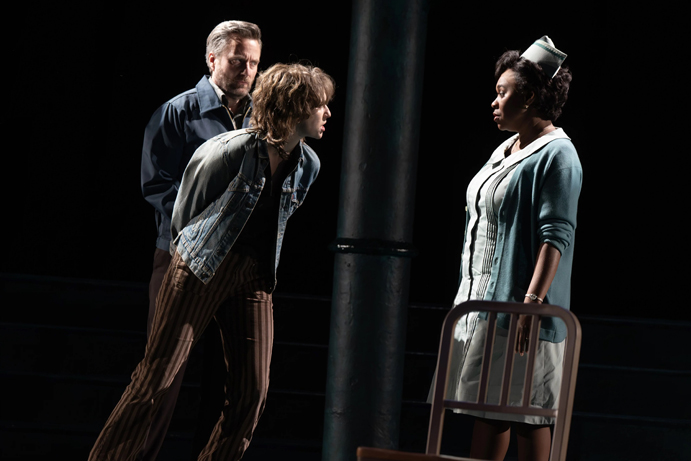
Manoel Feliciano, King Princess (Lisa), Ta’rea Campbell (Valerie)
We see a group therapy session. Unlike the melodramatic film which moved into the 1990s, this production reflects its era of origin. The girls watch tv news about Vietnam, protesters (“Right on!” they declare, fists up), and the assassinations of Martin Luther King and Bobby Kennedy. “These were the years of America I missed in here,” Susanna reflects. Was it safer outside? Told she’ll never be a writer, even that anchor becomes shaky.
Several characters descend into deep psychosis and act out. A couple, to the painful frustration of their peers, are forced to return to environments that bred or exacerbated mental disorder. One decides she’s where she belongs.
Determined to be released after an unexpected two years, Susanna finds a way to “compromise” that apparently existed, but seems more appropriate to the 19th century.
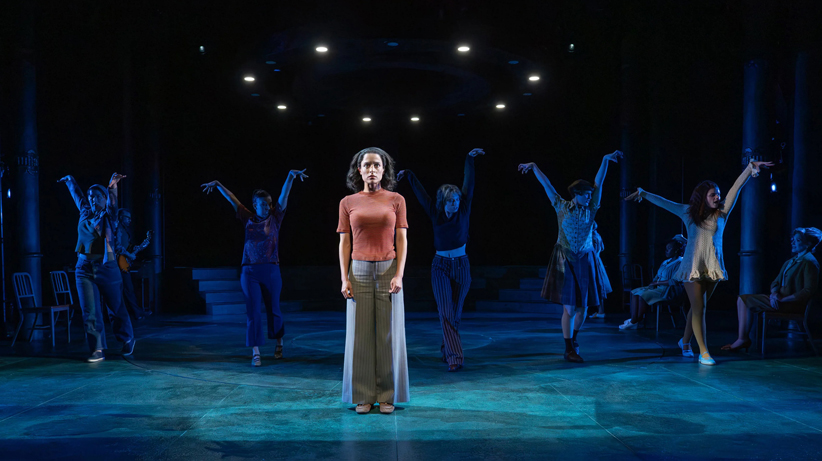
Juliana Canfield (Susanna) and the company
Director Jo Bonney creates deceptively calm atmosphere and specific characterizations. The girls’ dependence on and affection for one another is palpable. Written years after incarceration, Majok’s book distances itself from events. Bonney meets this half way. Though it could me more emotional, the piece works. Episodic scenes transition fluidly. Musicians are well integrated.The cast is wonderful.
Scenic Design by DOTS features what appears to be a circular blue cage or bell jar (as in Sylvia Plath) suspended above, ready to drop on/confine. Curved walls lower when location demands.
Costumes (Sarah Laux) are expertly chosen to reflect each character.
The title was inspired by Girl Interrupted at Her Music .(Johannes Vermeer- at The Frick Museum) In the painting, a young woman is diverted while playing music and looks away from what she was doing.
Photos by Joan Marcus
Opening:Katherine Reis (Daisy), Mia Pak (Grace), Juliana Canfield (Susanna) Gabi Campo (Tori), King Prince (Lisa),
Sally Shaw (Polly)
Girl, Interrupted
Based on the book by Susanna Kaysen
Book by Martyna Majok
Orginal Music- Aimee Mann
Music Direction- Andrea Grody
Choreography- Sonya Tayeh
Directed by Jo Bonney
Through July 12, 2026
The Public Theater 425 Lafayette Street at AstorPlace
https://publictheater.org/