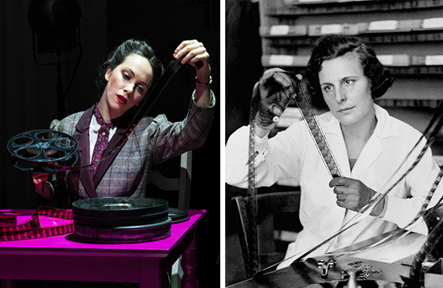
By Alix Cohen
Leni Riefenstahl (1902-2003) was a German actress, photographer and filmmaker best known for the last, making propaganda movies in service of Adolph Hitler. One of the few women to direct in Weimar Germany, she won a silver medal at The Venice Film Festival for her mystical The Blue Light, in which she starred. When it was unpopular with critics, Riefenstahl blamed it on those who were Jewish.
Adolph Hitler was a fan of the film and thought the young woman epitomized a perfect Aryan German female. She, in turn, was mesmerized by his speaking. In 1935, at his behest, she directed the documentary style film, Triumph of the Will, on the Nazi Party Congress in Nuremberg. A highly orchestrated piece of propaganda designed to glorify Hitler and the Nazi regime, the film utilizes dramatic camera angles, large-scale crowd scenes, and carefully staged imagery. It presents the Party as powerful, unified, and almost mythic, promoting ideals of loyalty, strength, and national unity.
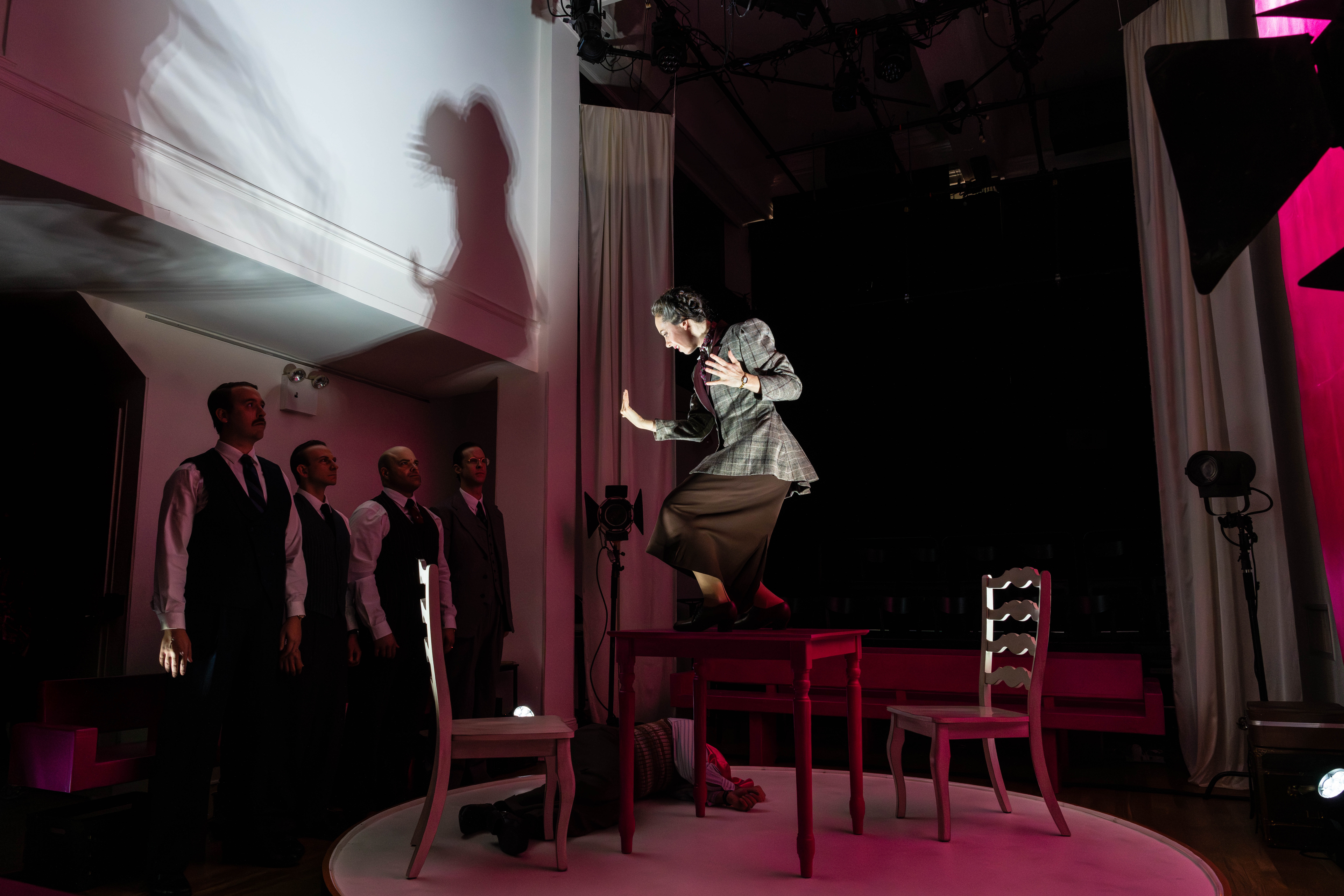
Baize Buzan (Leni Riefenstahl ) and The Company
Despite the film’s deeply controversial and disturbing political purpose, the work is often studied for its innovative film making techniques and its role in demonstrating how cinema can be used as a tool of persuasion.
1938. Leni Riefenstahl (Baize Buzan), stands atop a table wearing a neat, conservative skirt suit and practical, lace up heels. When admitted to the office of Joseph Goebbels (Peter Coleman), Reich Minister of Propaganda, she climbs down and takes a seat before it’s offered. Initial dialogue is German. Use of the tiny stage is inspired. Other cast sits in a row off to one side. Entrances and exits are minimized.
Riefenstahl, now friendly with Hitler, (they may have been lovers), has been commissioned to make a film on the upcoming Olympics called Olympia. With an unlimited budget and the Fuhrer’s ear, the opportunity is irresistible.
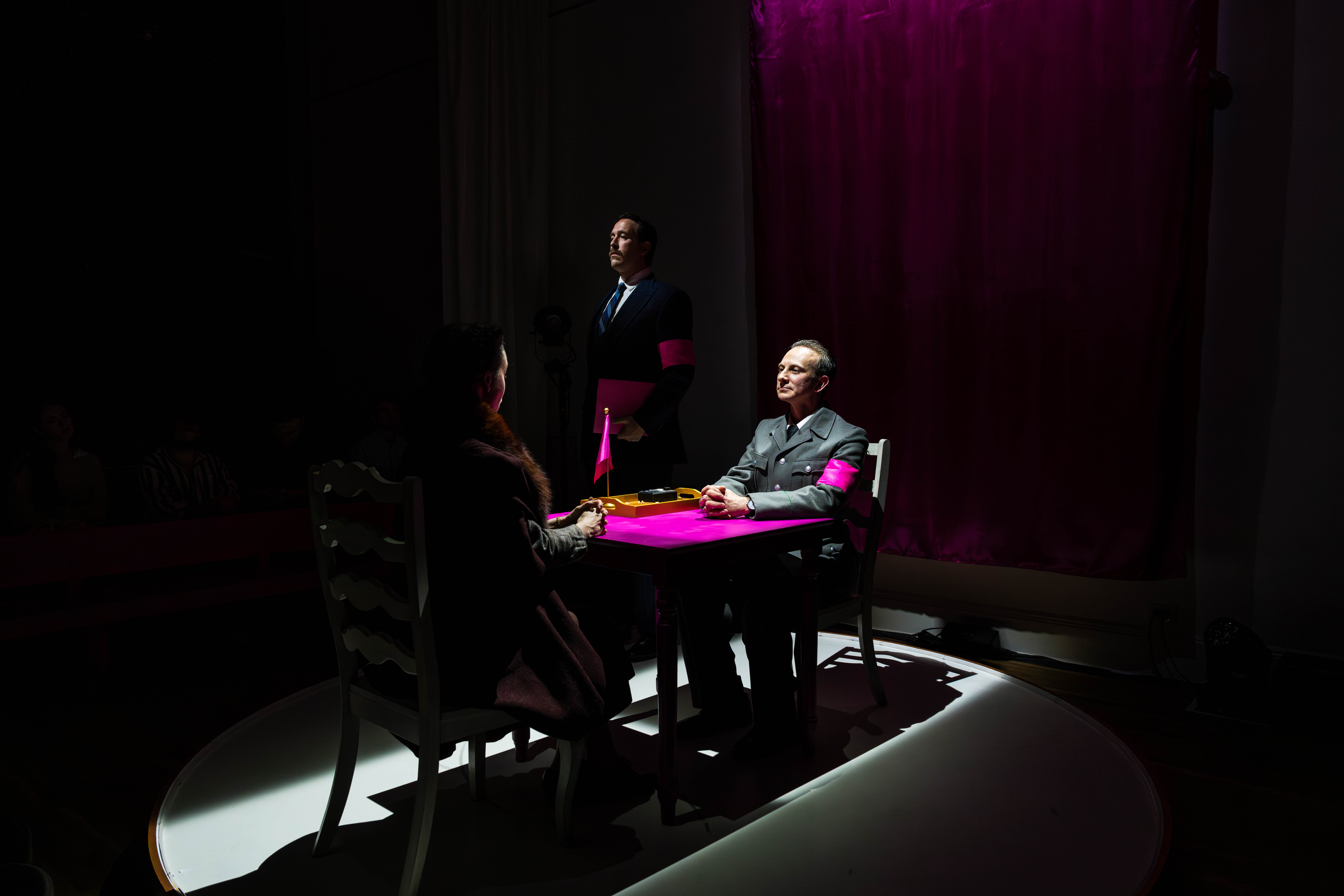
Baize Buzan (Leni Riefenstahl ), Sam Hood Adrian (Werner), Peter Coleman (Goebbels)
The protagonist is a mix of artistic brilliance, relentless ambition, and deep moral controversy. She’s cocky to the point of being unapologetic or deflective and plies seduction as needed. Goebbels is not susceptible. Hitler may have been. Others will be.
The minister is pompous. He tells her she was not his first choice. “It’s lucky then there’s only one opinion that really matters,” she purrs. He sarcastically notes Riefenstahl’s dreams of Hollywood via her “sports film” might be shattered. The budget is 1.5 million Reichsmarks – roughly equivalent to $12 million to $25 million+ USD in purchasing power.
Riefenstahl celebrates her friend Ernst’s (Keith Rubin) birthday. Though he wrote the script to Triumph, he calls it “drivel.” They seem like a couple, but are not. Ernst is married to a Jewish woman. He tells his friend that Olympia is “unconscionable.” She points out they both need the money. Ernst signs on for his own reasons. He remains the voice of conscience.
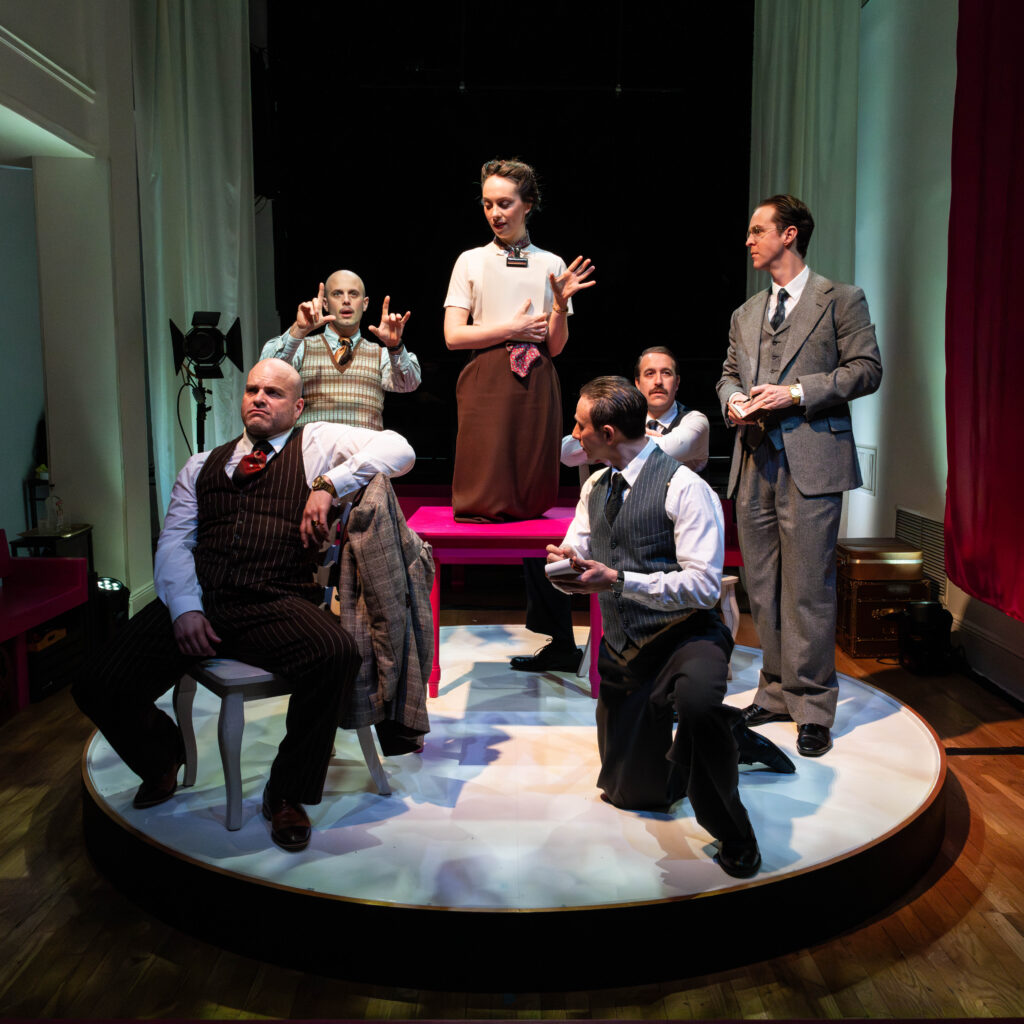
Baize Buzan (Leni Riefenstahl ) and The Company
We meet Max (Luca Fontaine), a gay tailor of which both she and Ernst are fond. When he’s picked up by the Nazis, Ernst begs her to write a letter to the Fuhrer. Both believe “He wouldn’t hurt a fly!” They compose it together. Machiavellian language is fascinating. It never gets sent.
The four men stand around the circular stage (audience on two sides). Each opens raised fingers on both hands to let a single length of film pass through. It’s a beginning and a trap. “We are commencing a noble undertaking…It matters not what is true, only what is beautiful…” (LR)
Olympia is one of the first films to use a tracking shot, placing a camera on rails to follow athletes’ movement. The director employed slow motion for diving, high and low shooting angles, and panoramic aerial perspective. “Film the Fuhrer from below to elevate his face from the crowd. Be sure the camera captures the depth in his eyes.” (LR)
Its international debut leads to an American publicity tour in attempt to secure commercial release. “Our neighbors are seeing wisdom, but the US is holding out…You may promote the film, but also promote our way of life. They are overrun with Negroes and Jews, ripe for education…You know the sort of thing, shake hands, kiss babies, eat pretzels.” (JG)
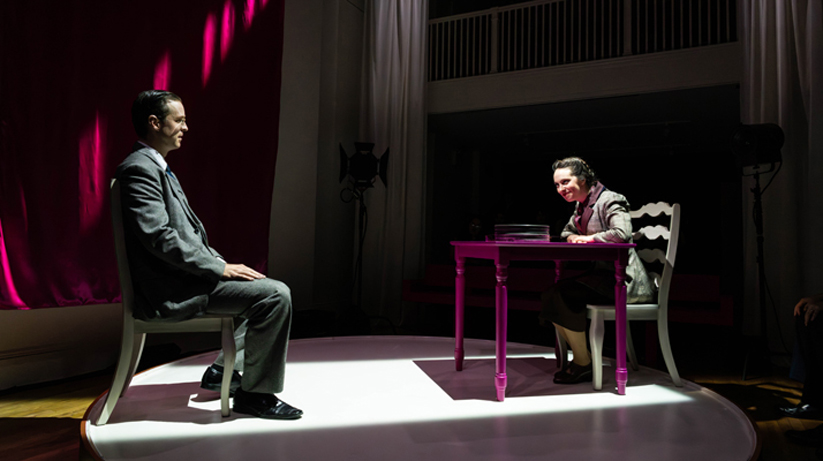
Keith Rubin (Ernst) and Baize Buzan (Leni Riefenstahl )
Riefenstahl is accompanied by Ernst and Nazi lackey, Werner (Sam Hood Adrian.) They are supposed to be tourists. At a drunken dinner a deux, (Buzan is wonderful) the German ambassador, practically licking his lips, shares what’s going on back home, assuming his guest knows. Riefenstahl does not, reacting with surprise and abhorrence. (Great direction.)
Anti-Semites Walt Disney (playwright James Clements) and Henry Ford are cordial but unhelpful. The three visitors are shunned or protested. “I’m not a Nazi, I’m an artist!” Riefenstahl insists.
A late-in-the-play conversation with Ernst vividly shows her blinders. “I think you’ve decided to make peace with some very unsavory things,” he begins. Discourse will make you shudder. Much of this beautifully written play will make you shudder. Its finale is superb.
After the war, Riefenstahl was arrested and held in various prison camps, but never charged with war crimes. She denied having known about the Holocaust, filing and winning over fifty libel cases against people accusing her of complicity in Nazi crimes.
“I was one of the millions who thought Hitler had all the answers. We saw only the good things; we didn’t know bad things were to come.”
Next to Orson Welles and Alfred Hitchcock, Riefenstahl is thought to be the most technically talented filmmaker of her era. Also conceivably amoral, corrupt, and ethically bankrupt.
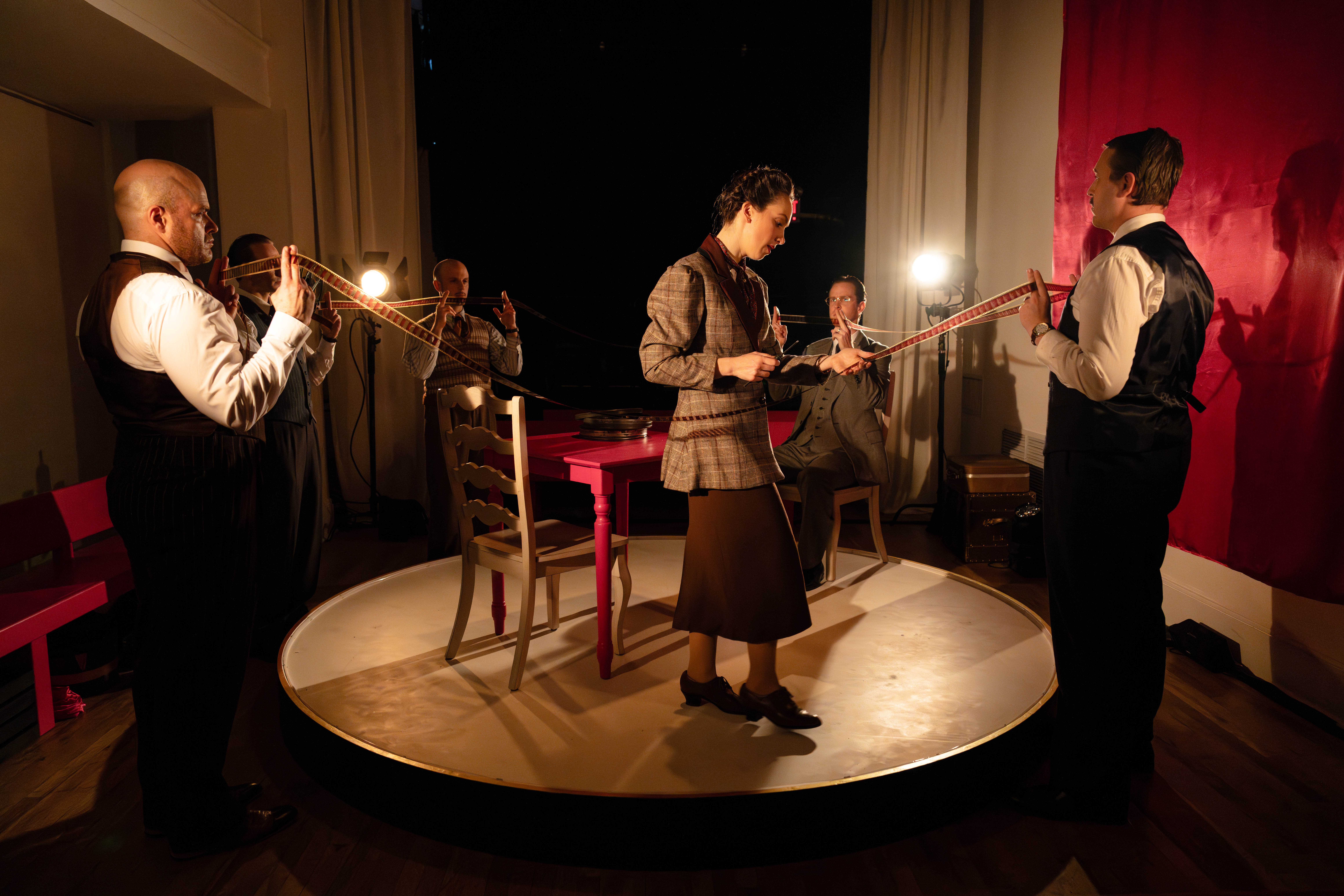
Baize Buzan (Leni Riefenstahl ) and The Company
Playwright James Clements fits considerable history in an hour forty (just right) without ever seeming pedantic or preachy. His perception of the heroine is as credible and unnerving as Nazi speeches. Narrative is never less than compelling. Ancillary characters serve to illuminate factions. The piece packs a wallop.
Direction (Danilo Gambini) is marvelous. When characters speak German, the language emerges in precise English. In America, English arrives with German accent. The small space is used with variety and purpose. Drama is controlled. Focus holds us.
Baize Buzan offers a multi-layered Leni, on the one hand over confident and exhilarated, on the other, anguished by the behavior of those in whom she’s put her faith. (Not anguished enough to go home and quit, however) Flirting is heated. As Riefenstahl, the actress grows increasingly frustrated, angry, and stubborn. We watch the character lose her bearing, yet she remains upright.
The cast is very fine with Keith Rubin standing out as Ernst. Understated performance is solid and calm. We lean in when the actor talks. Peter Coleman’s officious Goebbels is reptilian in the actor’s measured delivery.
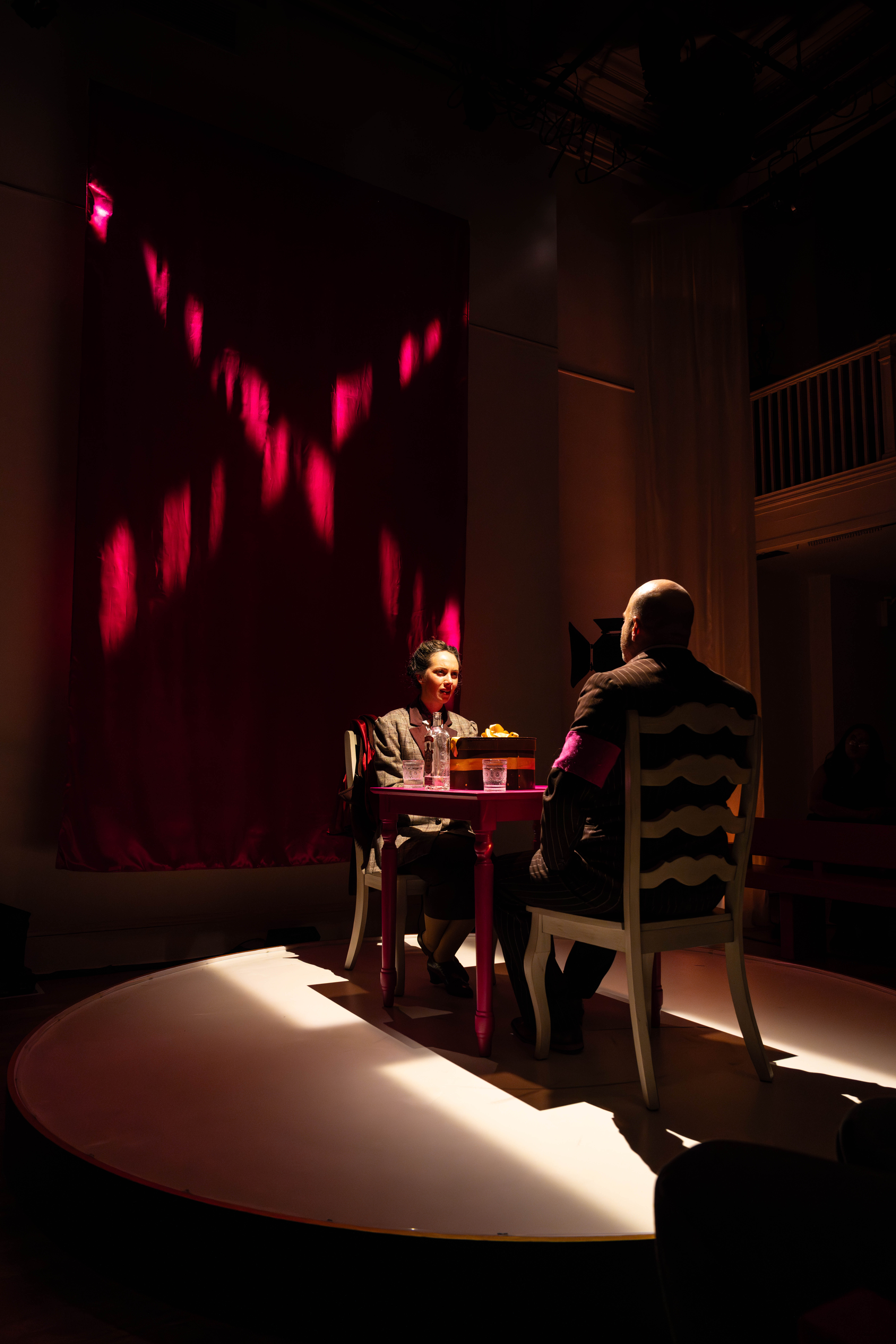
the German Ambassador
The sparse set, by Suzu Sakai, is accented with jarring pink. Perhaps the choice is meant to echo pink triangles assigned to men in the camps accused of homosexuality. Perhaps it’s meant to be oblivious to horror.
Limited props (Samantha Tutasi) are well chosen and used to excellent effect. Oh, Mickey Mouse! Oh, the cake!
Costumes by Stephanie Bahniuk aptly represent station, status, personality, and period. Max has flair. After Olympia is complete, Riefenstahl trades her suit for a fur collared cape.
Lighting (Yung- Hung-Sung) is atmospherically handled in what must be a difficult physical set-up. Shadows are evocative.
Sound by designer Liam Bellman-Sharpe is subtle. Overlapping radio voices, drums, period music, and especially the quiet clacking of rolling film enhance throughout.
Performance Photos by Alexia Haick
Opening Baize Buzan & Leni Riefenstahl 1935 (Public Domain)
The title is printed upside-down and right-side-up juxtaposing The Fuhrer and Frau Riefenstahl
What Will the Neighbors Say? & The Cell present
Beauty /Freak by James Clements
Directed by Danilo Gambini
Through May 17,2026
The Cell Theater 338 West 23rd Street
https://www.thecelltheatre.org/