Review by Ron Fassler . . .
As an avid theatregoer and critic, I consider myself fortunate that at the age of twelve, I saw the original 1969 Broadway production of 1776. A critic even back then, I attended its second-to-last preview, a Saturday matinee before its Sunday night opening, and came home to my parents bursting with enthusiasm. Sneaking in on the last day of Tony Awards eligibility, two days later it received six nominations, followed by snatching the Best Musical and Best Director prizes from the clutches of Hair, Promises! Promises, and Zorba. Running for three years, and due to my youthful enthusiasm, I saw 1776 a total of thirteen times. And as one of my very favorite musicals, I try and see it whenever I can out of sheer pleasure. So, it’s a pleasure to report that its revival at Paper Mill Playhouse in Milburn, N.J. is a joy from beginning to end. Artistic Director Mark S. Hoebee has helmed this one himself and has done a bang-up job keeping it lively and preserving some of the best aspects of the original production, which I can attest to with first-hand knowledge.
Though produced regularly for more than fifty years,1776 is popping up all over the country as this July 4th marks 250 years since the signing of the Declaration of Independence. One of the best things about the dramatic tension the show supplies is that you would have to have failed American History in school to not know that the Declaration was signed on July 4th. Yet it’s the brilliant conceit of this musical to have a large calendar onstage; its pages torn from when the show begins on May 8th until that moment when the page is torn off to reveal July 4th. Right up until that moment, it seems it will never happen. In almost a one-man battle, John Adams of Massachusetts strives for the thirteen colonies to declare itself a nation in order that George Washington’s rag-tag collection of soldiers have a clear goal while battling King George III’s massive British army. This Revolutionary War was indeed revolutionary, put into words by Benjamin Franklin when he mentions that “No colony has ever broken from the parent stem in the history of the world!” It is simply magnificent to watch and listen how the truncated members of this stage version of the Continental Congress debate the issues, shrunk from 56 delegates to a more stage worthy 20. Peter Stone’s ingenious libretto for 1776 is considered so good that it can even stand up on its own as a straight play—a compliment of the highest order. That said, I believe Sherman Edwards wrote a first-rate score, one that often doesn’t get nearly as much kudos as Stone’s book does.
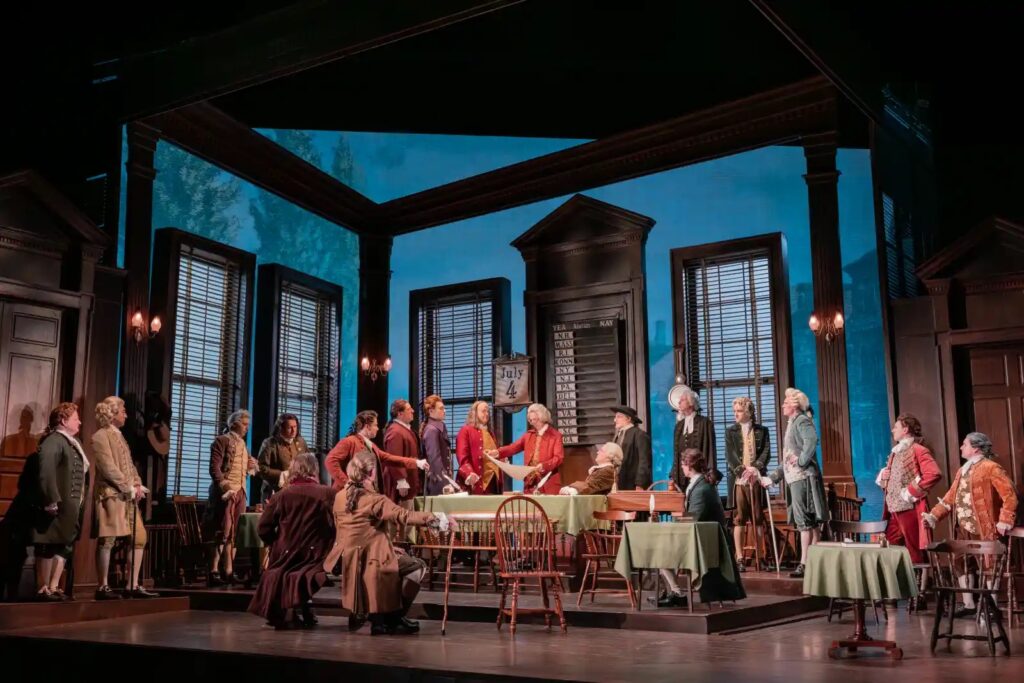
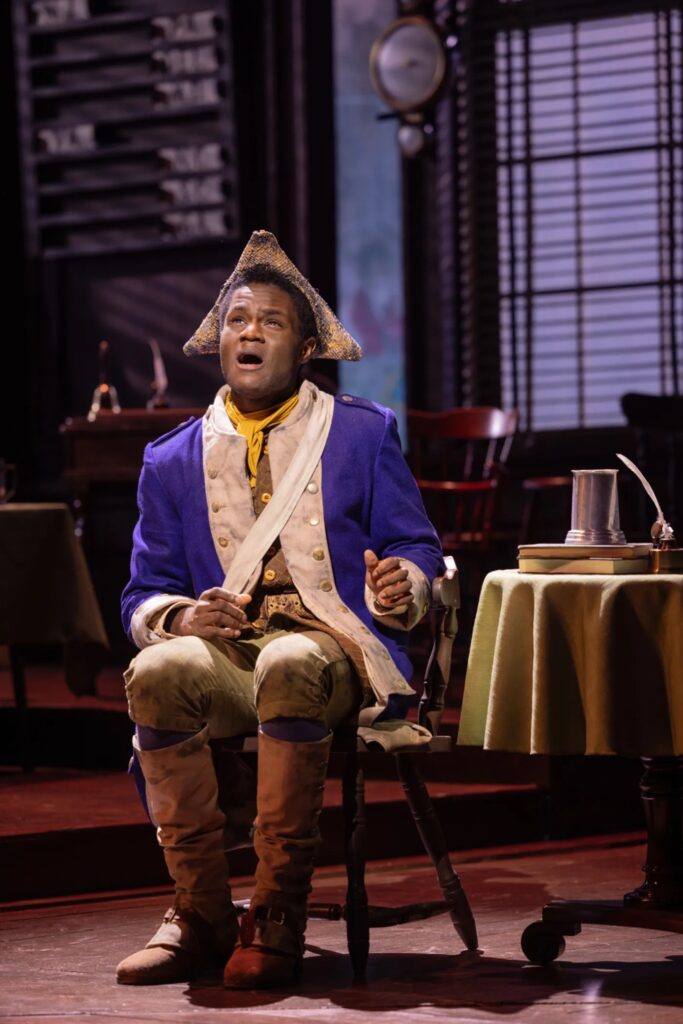
At Paper Mill, Kevin Rupnick has based his scenic design on that of Jo Mielziner’s original, which is wise. His use of sliding panels to camouflage the Congress whenever the action takes us outside its walls pleased me no end. The production is also sumptuously costumed by Leon Dobkowski, and Amith Chandrashaker’s lighting is effective in all the right ways. The musical direction by Jillian Zack makes the seventeen-piece orchestra positively sing, and Nancy Renée Braun’s choreography is filled with creative touches new to me (I did, however, find two numbers somewhat over staged, “But, Mr. Adams,” and “Cool, Cool Considerate Men”). And it’s a major boost that Hoebee, as director, gets so many solid performances from the majority of 1776’s large cast. Among the best are John Treacy Egan’s smooth and mellifluous Ben Franklin of Pennsylvania; Edward Watts as John Dickinson (also of Pennsylvania), the smart and elegant opposition to the United States of America; and the youngest member of Congress, Edward Rutledge of South Carolina, played with delectable unctuousness by Jonathan Young. I also very much enjoyed the twinkle Tuck Milligan supplies as Andrew McNair, the Congressional Custodian; the lovely singing of both Elena Shaddow as Abigail Adams and Liz Leclerc as Martha Jefferson; and Praise Oranika’s “Momma, Look Sharp,” who delivers the haunting ballad sung by a young soldier with a stinging electricity.
That leaves the musical’s central character of John Adams. As played by Will Blum, a strong singer, the decision to allow him to go for a broadly comic performance is a huge error. I found myself offended every time he would pinch his voice for comic effect and go for easy laughs. Adams, insufferable as he is, is not a silly person and that’s the problem with Blum’s performance—he comes off as asinine. Substituting anger for aching pain, he is too often shouting without the underlying commitment that fuels the character. I never got the sense that something in him would die if he were to lose on the issue for which he’s staked everything: his dream of a new nation, his very marriage, and his reputation. He seems petulant as opposed to passionate. Again, he’s physically right for the role, sings the hell out of the songs, and is not a bad actor—only misguided.
It’s a credit to this production that even with a less than successful turn by its lead, it doesn’t diminish how effectively this 1776 still plays. Paper Mill is to be congratulated for a fine production, performed as written with no extra flourishes, reminding us that 57 years ago, a little show that could showed everyone how it’s done. Now through May 2nd, it’s a visit well worth your time to see this stimulating, one-of-a-kind musical.
At the Paper Mill Playhouse, 22 Brookside Drive, Milburn, N.J; https://papermill.org
Photos by Evan Zimmerman for MurphyMade.
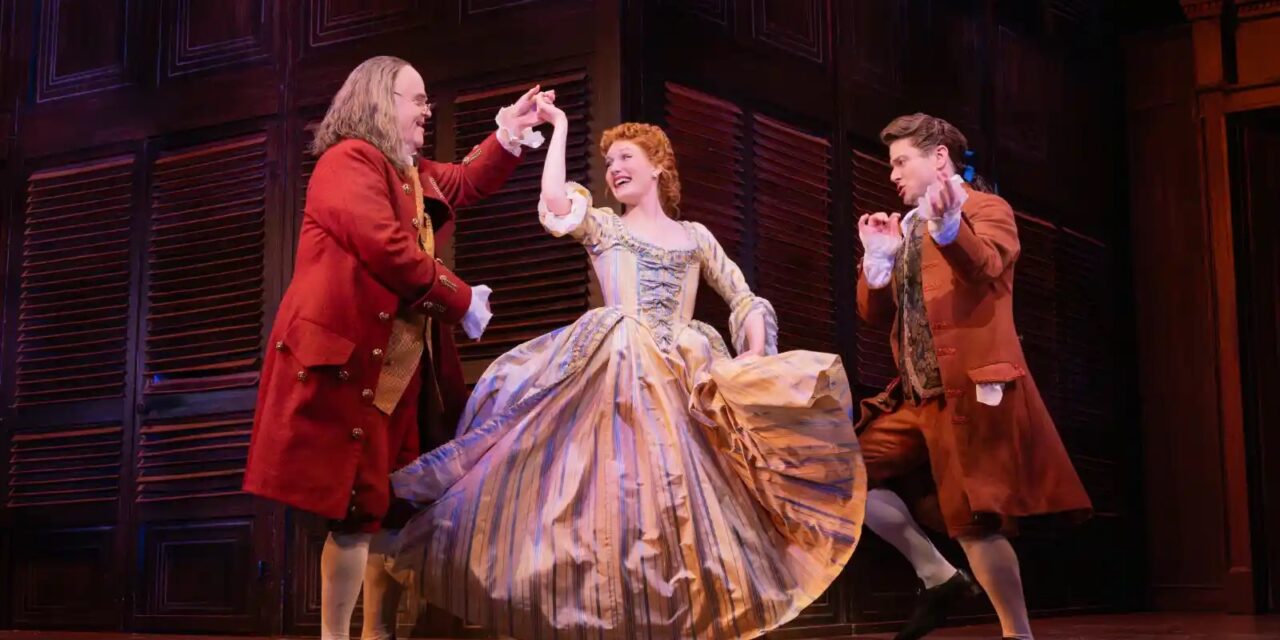
Headline photo: John Treacy Egan as Benjamin Franklin, Liz Leclerc as Martha Jefferson, and Will Blum as John Adams in 1776.