By Alix Cohen
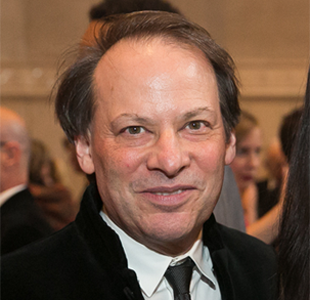
Adam Gopnik, master of the caffeinated essay (forty years at The New Yorker) and iconoclastic books, navigates culture with fluid elegance and restless curiosity. At the same time, he’s almost clandestinely traded expansive pages of prose for the rigors of libretto and lyric.
“I wanted to become some amalgam of E.B. White and Lorenz Hart, writing witty essays with one hand and witty lyrics with the other.” (Adam Gopnik – At the Strangers’ Gate)
Gopnik wrote his first musical, Monuments, at McGill University while studying art history. It was about the life of Vladimir Tatlin, an avant-garde Russian architect whose iron and glass Monument to the Third International was a symbol of revolutionary ambition in early Soviet culture. ‘Not the usual musical material.
While obscure subjects seem congruous with the development of a Renaissance Man, Gopnik didn’t focus solely on musicals in any of nine wildly diverse books. Little did we know, he’d secretly been writing songs since his teens. “I would take a chord sequence from a Gershwin or Rodgers song — I recall using “Sweet & Lowdown” and then give it a rock feel and invent new words. I had a notion that someone could combine the musicality of the songbook with the intimacy of the great singer-songwriters. This somebody turned out not to be me, but I still think it was a worthy idea.”
Gopnik’s parents were intellectuals. They listened to chamber and baroque music; Bach was considered exotic. Adam might never have acquired enthusiasm for musical theater had it not been for his grandparents appreciation. “Musicals were the forbidden fruit of my upbringing, which always tastes best.”
At the ripe age of eight, Grandmom and Grandpop took him to Broadway’s Fiddler on the Roof. It was a revelation. Gopnik’s next exposure to the art came from S.N. Behrman’s 1993 piece, Chez Gershwin, in, yes, The New Yorker. Waxing poetic about the brothers’ “enduring musical gems”, Behrman unwittingly propelled young Gopnik to the local record store in search of examples.
The teenager bought Ella Sings Gershwin with Ellis Larkins at the piano, deep dove into Fred Astaire films on TCM, and read Alec Wilder’s American Popular Song. “Now we have a real culture of The American Songbook. I had to search for it.”
Working out raw melodies on a guitar, Gopnik knew his interest “was not part of the living fabric of the music of my generation.” (He was also a self avowed Beatles maniac.) Pursuit flowed with singular intention. “I was and am a completist. I looked up everyone song by song.”
On a runaway trip to London with his then girlfriend, now wife, Martha, the young people saw Side By Side By Sondheim. “Once again, my head was turned totally upside down and around. It was a semi-religious experience…The revue seemed to do what I dreamed of doing.”
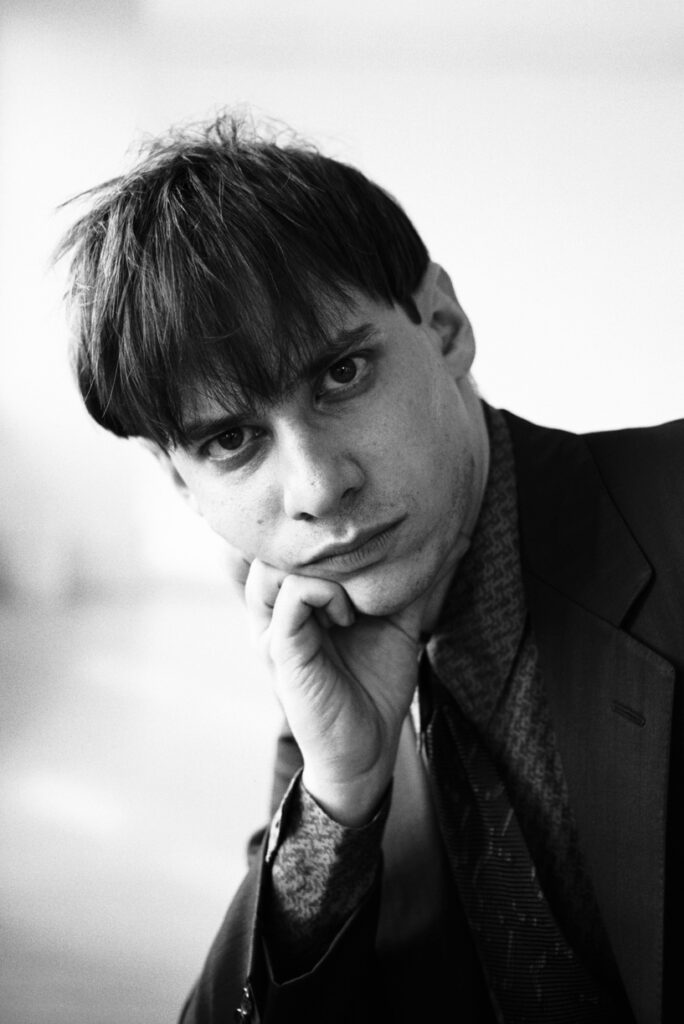
Young Adam
“A divide between what we now call ‘Songbook’ compositions — Porter, Gershwin, Hart, etc– and something wholly contemporary and non-nostalgic had been achieved by Steve. He did it on more purely Broadway terms than I might have imagined, but he did it.”
“It may have determined my vocation…except of course it didn’t. I’m still here… writing essays. But the second life as a lyricist — some seventy or eighty songs now published — is welcome. Better late than never — though I’m sure my critics will think ‘better never than late.”
“I met Sondheim eventually through (legendary photographer) Dick Avedon, a kind of father figure in my life, who knew him from their shared youth in the (Leonard) Bernstein circle… We got to be friends, often having intense discussions about musical theater, form, and possibility.”
“I thought it discreet not to show him my work too frequently. It was partly because everyone did, poor guy, and what was he supposed to say? And also because I firmly wear the white rose of Hart rather than the red rose of Hammerstein, and didn’t want to engage too often in that argument.”
Adam and Martha moved to New York. A cassette of the Tatlin show “which I was sure was 30 minutes from Broadway,” was sent to someone who knew the sister of Art Garfunkel’s psychiatrist. No kidding. They never heard back. Gopnik counts his not having pushed the piece harder as one of a very few regrets. He went to work for The New Yorker, relegating song writing to anniversaries, birthdays, and the occasional stand-alone. Rough melodies were sung into a recorder. Time passed.
One evening, composer David Shire (Baby, Big, Starting Here, Starting Now) laughed out loud reading an essay Gopnik wrote in The New Yorker. “I said to my wife (Didi Conn) that I wished that writers like Adam wanted to write musicals,” he recalls. “How do you know he doesn’t?” she replied. Shire tells me he assumed “writers like Adam would never want to work in such a middlebrow art form.”
Serendipitously Conn was at an awards show Gopnick hosted. She took the opportunity to ask whether he’d be interested in collaborating with her husband. “Nothing in the world I’d rather do,” he keenly responded. “I came to New York to write musicals and only took the job at The New Yorker to make a living which would allow me to do that!”
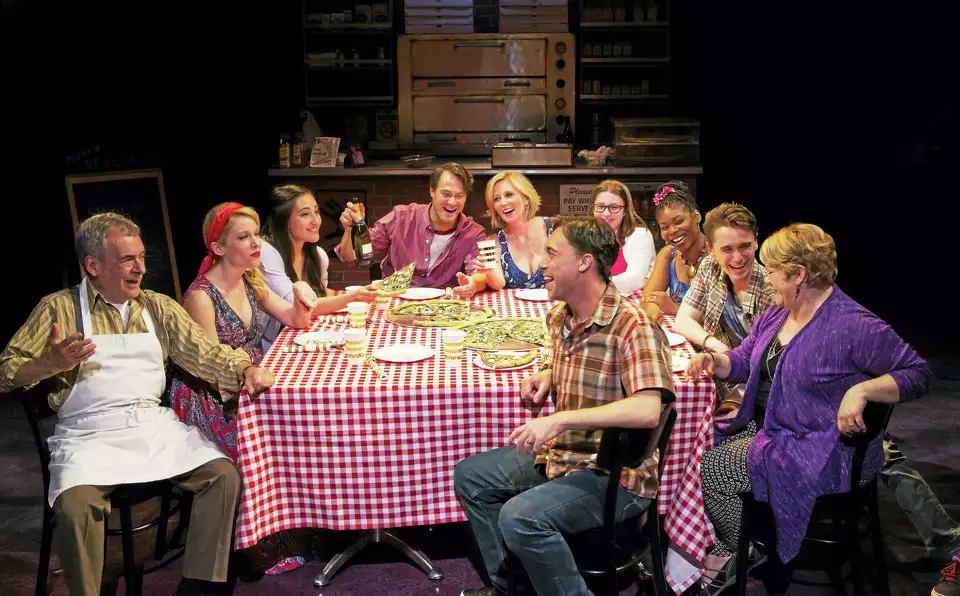
The Most Beautiful Room in the World– Photo by T. Charles Erickson
With mutual admiration, Gopnik and Shire began writing Our Table (now The Most Beautiful Room in the World) in 2007. The musical is a love triangle that takes place in a warm, gathering- place-type restaurant off Union Square that’s battling gentrification. Couples with whom Gopnik was friends, Chef Peter and Susan Hoffman who owned the Savoy and Chef David & Karen Waltuck who owned Chanterelle, provided background. Both labor-of-love restaurants are alas, gone. It evocatively begins: “The most beautiful room in New York/It’s an epicure’s womb in New York/Market flavors embrace/In an apricot space…”
Gopnik’s nonfiction book, The Table Comes First: Family, France, and the Meaning of Food, a collection of food writing from The New Yorker, furnished vocabulary. Its author is, in fact, himself a passionate chef. “At the start of our collaboration, Richard (Richard Maltby, Jr.) as the already experienced musical theater writer, had to teach me, a songwriter with almost no such theatrical experience, the craft of writing songs for a musico-dramatic vehicle,” Shire notes. “With Adam, at first, I was the much more experienced theater writer and he the student.”
“Initially his lyrics tended to be too complex since, as a master of prose expression, they tended to lack the economy of expression that good musical theater lyric writing requires. But, as I had been with Richard, he was a fast learner and soon was writing lyrics with the informed simplicity that we both admired so much in Sondheim’s lyrics.” (David Shire) The piece was produced at Long Wharf Theatre in 2017.
“I went to Steve (Sondheim) and asked why musicals were so hard”, Gopnik recollects. “I thought he would say ‘that’s the mystery.’ Instead, he answered, ‘The first ten minutes.In the first ten minutes, you’re telling the audience who will sing, why they’ll sing, and what the stakes are. His very Sondheimian point was audiences are actually nervous because the whole business of singing is so artificial. Even if they don’t know it, they’re a little tense. You have to relax them, showing things are totally under control, stating rules.”
Precedents include “Love Is in the Air” becoming “Comedy Tonight” (A Funny Thing Happened on the Way to the Forum), “Oklahoma, A Toast” becoming “Oh What a Beautiful Mornin” (Oklahoma), “We’ve Never Missed a Sabbath Yet” becoming “Tradition” (Fiddler On the Roof.) “I had the impertinence to say to him, “Oh really, Steve? The first ten minutes of Follies are quite complicated, we don’t know what the rules are.” (AG) “Follies has never made a penny,” Sondheim retorted.
Gopnik and Shire mounted a workshop and redesigned the beginning of Our Table. A former opening, “The Most Beautiful Room in New York” (prominent California chef Alice Waters’ quote about The Colony Restaurant) became “Your Table Will Always Be Waiting…” and then changed back. “The logic of using it was impeccable, but art isn’t logical — as Steve would have been the first to
say. The more intimate opening was right for an intimate show, this one required energy.”
Sondheim notoriously pillaged librettos for lyrics. Gopnik writes lyrics and libretto simultaneously. “One of the things I learned is not to write the song for the scene, a natural temptation for an essayist. There’s nothing left to say then. When an audience has gotten the emotional message, they don’t have hunger for it in a song.”
“It was an uphill climb to figure out what sang. To my often strenuous impatience, David taught me an enormous amount about this. Some of it is simple things like open vowels and that apostrophes are hard to vocalize… Paul Simon once made the point that you can’t turn back a lyric, which you can do with a sentence. It goes by. The audience doesn’t grasp it the way they do written words.I made a note to myself: Don’t aphorize, dramatize. My prose is very aphoristic.” (Aphorizing is the utterance of short, pithy sayings that convey a general truth simplifying complex ideas into concise statements.)
I ask Gopnik whether he sets himself secret challenges. Sondheim imposed constraints like “no repeated words” or ultra-tight rhyme schemes. Songs in Pacific Overtures reflect the rhythm, syntax and in one case, even single syllables of Japanese culture.
Many Cole Porter lyrics include coded references to his social circle or to queer culture that went unnoticed at the time. Lorenz Hart employed internal callbacks: Phrases quietly echo earlier lines with altered meaning.
In Our Table, Gopnik made sure that a polysyllabic lyric had to be followed by a song with monosyllables and now feels it’s a good rule. “Syllabic variety is the secret spice of the stage. Like turmeric, not easily tasted but experienced. Audiences don’t hear the variations, but they feel it.” He’s also a great fan of inner rhymes.
I inquire whether he feels it necessary to tone down/popularize lyrics. “The truth is I found that I had to and I also seem incapable of it. I hope it’s not highbrow in some showy way, but I like intellect and ideas.”
“Be subtle, various, ornamental, clever,/And do not listen to those critics ever/ Whose crude provincial gullets crave in books/Plain cooking made still plainer by plain cooks.” He quotes W.H. Auden
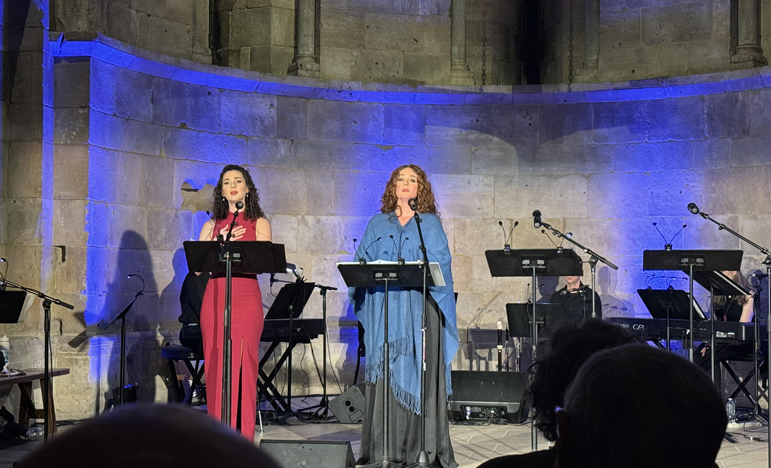
Shereen Ahmed (Eleanor’s daughter Marie) and Melissa (Eleanor, Queen of France) in Eleanor
Gopnik’s next musical with Shire, Eleanor, is a story by which the latter had long been intrigued. It centers on the 12th century Queen of both France and England, Duchess of Aquitaine, mother to kings like Richard the Lionheart. “What do you own when you’re owned by a king?” Eleanor lyrically sings. “David’s style is medievalism, but it’s not a medieval score…He comes in with beautiful music- ‘I got this gift last night’– which invariably solves a dramatic problem we’re working on. He’s unique in the purity and scale of melody.” (AG)
It was in Eleanor’s court, the writers theorize, at which romantic love songs, ideas of love and chivalry, were born. Surviving ballads of the great troubadour Bernard de Ventadour offered inspiration. The character has become what Gopnik calls a Donald O’Connor type. His friends are bawdy. “With David’s help I learned, here we need a comedy song, here a ballad.”
It opens with a contemporary professor named Ellie for whom the queen was “avatar, familiar, obsession, and cause.” The academic teaches “a seminar in cultural cause studies with an emphasis on anti-patriarchal myth making and an exploration of the invention of emotions.” It’s her hypothesis that in song, romance follows form, not vice versa.
Gopnik calls himself “a romantic of the 18th century ‘sentimental’ kind rather than the tempestuous 19th century kind.” You can take the writer out of his bailiwick, but penchant for elevated thought remains. The piece fittingly debuted at The Cloisters in Aquitaine’s own chapel with Gopnik’s long time muse/interpreter Melissa Errico as the heroine.
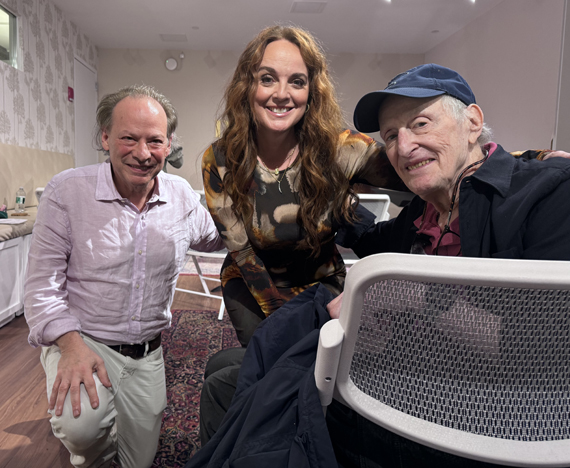
Adam Gopnik, Melissa Errico, David Shire
We can almost hear Shire’s lush melody in these lyrics: “Shadows are all we have to show/The shapes that light can make/Darkness is a gift to show the forms/That light can take/Bless each shadow, bless each pain/ Seek the sun, but see the rain…”
Between Our Table and Eleanor, Andrew Lippa (The Wild Party, The Adams Family, Big Fish) came to Gopnik asking if he’d be interested in writing the libretto for Fairytale, the story of a father and son in 1973 coming to terms with the son’s gayness.
Gopnik initially turned it down believing he didn’t know enough about the subject.
Then, he tells me, his daughter came out “and for the first time I understood what it was like to have a child you adore that has some part of him/her that’s been shut off.” Fairytale goes into workshops next month under the aegis of director Nicholas Hytner.
“Adam is a consummate collaborator,” Lippa tells me. “ Having toiled many years as a literary soloist, I am constantly struck by his power and passion for teamwork. He writes the book, co-writes the lyrics (with me), and has as much to say and contribute to the shape of the music as I do to the shape of the drama. He taught me the value of withholding emotions in writing until the absolute perfect moment in the show for a rush of feeling. His heart is big but his brain is bigger. I’m the opposite. So, we make a good team.”
A commission to write a musical of Alice Through the Looking Glass for Canada’s Stratford theater is next for this partnership. Gopnik feels ‘Looking Glass is more interesting than Carroll’s/Dodgson’s first effort. Its inspiration, Alice Pleasance Liddell, was a teenager by then. The book reflects a change in tone.
There are substantial differences in choices and writing style between the work of David Shire “who may be the last great lyrical composer” (AG) and more contemporary practitioners like Andrew Lippa, Adam Guetell, and Jason Robert Brown of whom Gopnik is a fan. These three artists might be considered “the Holy Trinity” of modern, sophisticated musical theater. Their writing often prioritizes momentum, character psychology, and irregular phrasing that doesn’t land on a clear, predictable beat over traditional, soaring lyricism.
Gopnik says he’s not more comfortable in one mode or the other. “It’s Updike’s theory of yes. John once said to me – he had a beautiful supercilious manner- ‘You have to decide if you’re going to be a ‘yes’ writer or a ‘no’ writer. I think you’re a ‘yes’ writer, so just say ‘yes’ to everything and you’ll find you waste much less emotional energy worrying about what to write than just writing.”
Additional work includes a libretto for Sentences, an oratorio on Alan Turing composed by Nico Muhly. With composer R. Stewart Wallace, Gopnik is working on an opera libretto based on Stephen Greenblatt’s Pulitzer Prize-winning book, The Swerve: How the World Became Modern “about a weird quest for a missing manuscript in 15th century Italy.” ‘Not to mention writing stand-alone songs.
As the writer both lived in and wrote about Paris, I ask whether there’s a French subject on his proverbial bucket list. He hopes to adapt The Dentist and the Empress: The Adventures of Dr. Tom Evans in Gaslight Paris by Gerald Carson. The book chronicles Thomas W. Evans, an American dentist to European royalty, highlighting close ties to Empress Eugénie and a daring role in rescuing her during the 1870 fall of the Second Empire.
One might wonder how the wordsmith finds time to write musicals as well as books and essays, performing his own monologist show, interviewing, lecturing, creating podcasts. Gopnik’s mind works pinball fast; articulation is dense. He has never, knock wood, suffered from writers’ block.
“I’m one of the few writers I know who just loves to write. You’ve got an artisanal task- a cabinet to build. Just build it,” Gopnik says with an implied shrug.
Opening Photo: This file is licensed under the Creative Commons Attribution-Share Alike 4.0 International license.