By Ron Fassler . . .
Anyone serious about theatre will most likely recall their introduction to Arthur Miller’s Death of a Salesman. At age eighteen, when director Mike Nichols saw its original 1949 production, he claimed it changed his life. Philip Seymour Hoffman, who went on to play its central character, Willy Loman, in Nichols’ 2012 Broadway revival said, “Before I even thought of being an actor, I was in high school, and the play destroyed me.” Playwright and screenwriter Tony Kushner has said that watching his mother perform in Death of a Salesman when he was a small boy gave him the idea of becoming a playwright (a film version he’s adapted is scheduled to shoot this year with Jeffrey Wright and Octavia Spencer as Willy and Linda). Salesman’s influences are everywhere and productions of it after its premiere seventy-seven years ago remain ubiquitous. With that, does a sixth Broadway revival which opened tonight at the Winter Garden Theatre, directed by Joe Mantello and starring Nathan Lane and Laurie Metcalf, beg the question: “Do we really need another interpretation?”
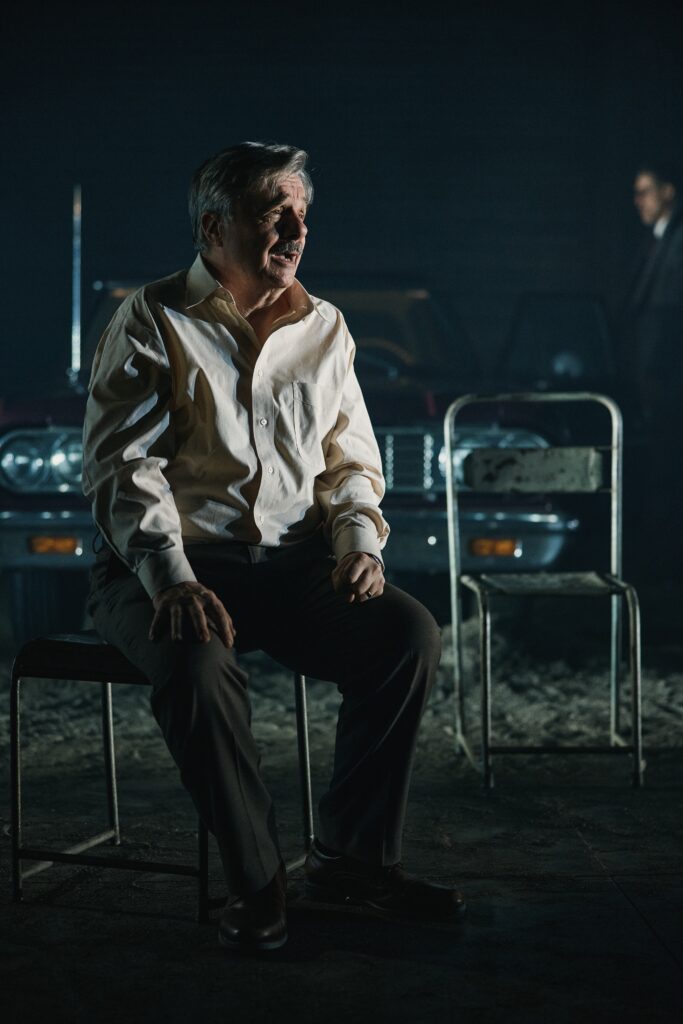
Yes, we do. Hell, yes! There’s always a reason to revisit Death of a Salesman and this time the creative team involved are doing some of the best work of their long and varied careers. The casting of Nathan Lane does not signal—as has been suggested—some sudden left turn by one of the great comic actors to tread the boards (this is his 25th Broadway show). For those who have been paying attention, Lane has always possessed a profound ability to tap into an intrinsic, sad nature even in his most outrageous comedy roles. Here he straddles the multitude of Willy’s character traits that are perpetually parked upon a precipice: his self-regard, sentimentality, gut-wrenching pride—even his alarming nastiness. Lane unstintingly plays Willy as the broken human being he has become (“a man with the wrong dream,” as Biff describes his father). Abandoning his bag of tricks vocally and physically, Lane’s commitment is all-in. Much like the great clowns before him, Bert Lahr and Zero Mostel, Lane has followed them in some of their most iconic roles—he is a tragedian at his core. At seventy, he is still at the peak of his powers so here’s hoping he intends to return to the stage in the years still ahead of him to keep challenging himself to theatre that matters. Not as Roger De Bris famously decried in The Producers, “wasting time on frivolous musicals.”
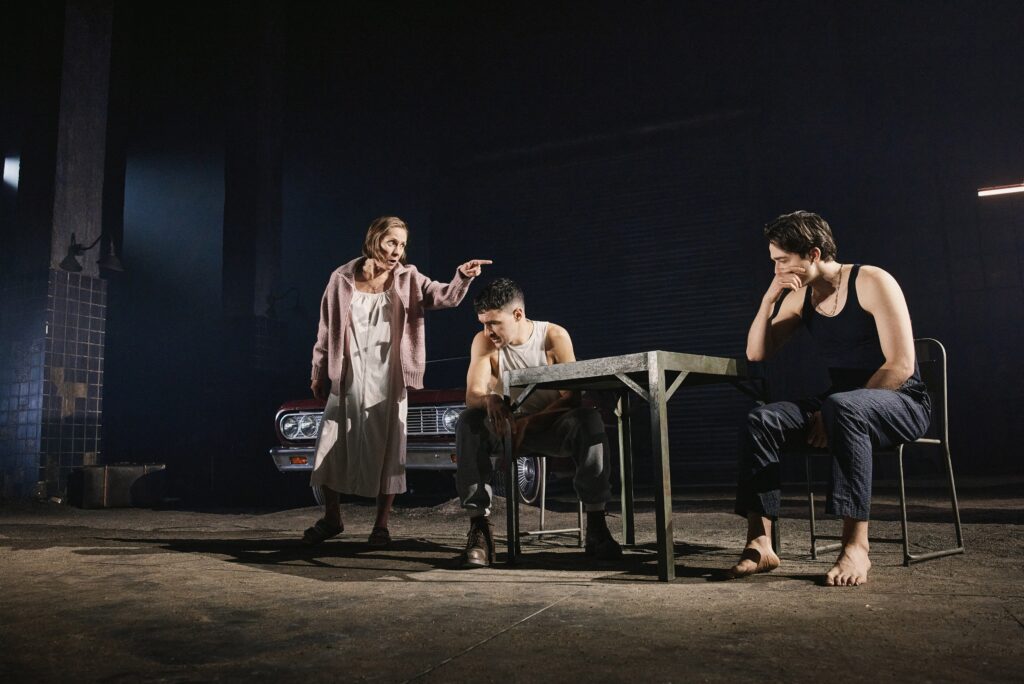
Teamed with Laurie Metcalf as his Linda, with whom Lane last shared a stage nearly twenty years ago in David Mamet’s November (also directed by Joe Mantello), a believable marriage is easily established. Affectionately caressing his wife’s cheek one moment, then lashing out at her to be quiet in another, this Willy and Linda are a couple who have clearly lived a hard-scrabble life together, bound in profound devotion. And as she did earlier this season in Samuel D. Hunter’s Little Bear Ridge Road, Metcalf once again proves herself the exceptional stage actress she is. Her ability to embody a bounty of original choices—a line here or a gesture there—continue to astonish. Offering a flinty honesty and a backbone of steel where her children are concerned, she also sublimates herself to a difficult man like Willy with sublime empathy. Always one hundred percent present, this Linda feels not just like an anchor to her family, but to this production as well.
As for Christopher Abbott and Ben Ahlers, they are perhaps the best Biff and Happy I’ve ever seen in being both physically right for the parts and the perfect ages to play them. They work beautifully together and Abbott’s Biff, stricken by remorse and a relentless conscience, comes off the exact opposite to Ahlers slick and vacuous Happy. Abbott is brave enough to fully embody the loser Biff is by sporting a bad haircut and wimpy mustache that completes the portrait. His self-flagellation is all too real and reaches its crisis point with staggering intensity. In one lightning bolt of a moment, he shocked in a way that will forever haunt me.
Ahlers, so good as Jack Trotter in The Gilded Age (currently idling between its third and fourth season on HBO), delves into Hap Loman with a revelatory range of emotions. In the second act while confidently flaunting a charm and brazenness while picking up an attractive woman in a bar, he also shows off how clueless he is to what little he’s learned about life . . . just like his father.
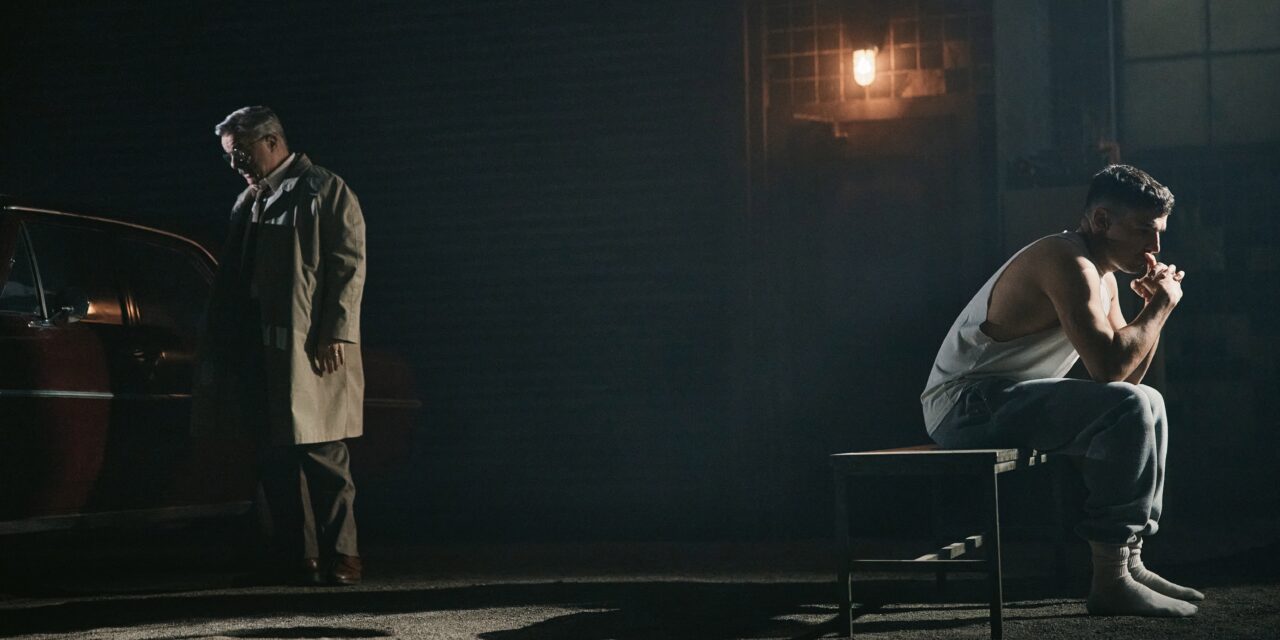
Under Mantello’s insightful staging this is a very differently crafted Salesman, especially in its abstract set. With designer Chloe Lamford, for whom this marks her third Broadway outing, she and Mantello have conceived an enormous industrial garage, presumably one where Willy parks his car. The first image is Willy driving onto the stage in his sedan, one final park after all those years on the road. Slowly, it is revealed that what Mantello and Lamford seem to be up to is something of a nightmarish three-hour swirl, possibly taking place solely in Willy’s mind. Overall, it works through utilizing no scenery and using substitutions such as benches for beds, though the Winter Garden’s massive stage does threaten at times to overwhelm the action.
There’s a bigger issue with some of Rudy Mance’s odd choices in costuming. For some reason, the play seems to be updated to the early 1960s, which doesn’t overburden it, although things like Willy attempting to survive on a $50 a week salary isn’t as believable as it was in 1949. Weird anachronisms from the sixties show up such as Willy’s boss Howard (John Drea) wearing a fleece vest at work with loafers and no socks while carrying a coffee cup with a plastic lid, which feels more like the 1970s. And why is Willy’s brother Ben (Jonathan Cake) dressed in a business suit, considering that he’s someone who, in Willy’s mind at least, never left the jungle? Whether the idea is to create a cacophony of images set across periods in Willy’s life, rattling around inside his head, is unclear. The evocative lighting by Jack Knowles, a top British designer, is first-rate as is the music composed by Caroline Shaw, for whom this marks her Broadway debut.
This is also the largest cast of a Death of a Salesman ever put onstage with the addition of three male actors who play younger versions of Biff (Joaquin Consuelos), Happy (Jake Termine), and Bernard (Karl Green). It’s always been a bit of a heavy lift for actors in their mid-thirties to convincingly convey the youth required for these roles in the play’s frequent flashbacks. So, in the second act scene when Willy gets a surprise visit from his son in Boston, Biff’s being played by the twenty-three-year-old Consuelos adds a meaningful poignancy.
The word remarkable is said by Willy six times throughout the play. “Isn’t that remarkable?”, he says about everything from misremembering the car he’s been driving, to the once-awkward Bernard having grown up to become a lawyer who will argue in front of the Supreme Court, and to his realization that Charley is his only friend. He also says it of the moment when father and son share their one true moment of connection. “Isn’t it remarkable?”
Where the production is at its best is with the four actors who make up the Loman family. When they’re onstage, remarkable is the word for this Death of a Salesman.
At the Winter Garden Theatre, 1634 Broadway, New York; https://salesmanbroadway.com
Photos by Emilio Madrid.
Headline photo: Nathan Lane as Willy Loman and Christopher Abbott as Biff Loman in Death of a Salesman.