By Alix Cohen
Felix Mendelssohn (1809-1847) was a German composer, pianist, and conductor of the early Romantic era, famous from childhood, known for his melodic elegance and clarity. This is a story about his sister Fanny (1805-1847), virtuoso pianist and subjugated composer, with 400 works to her credit.
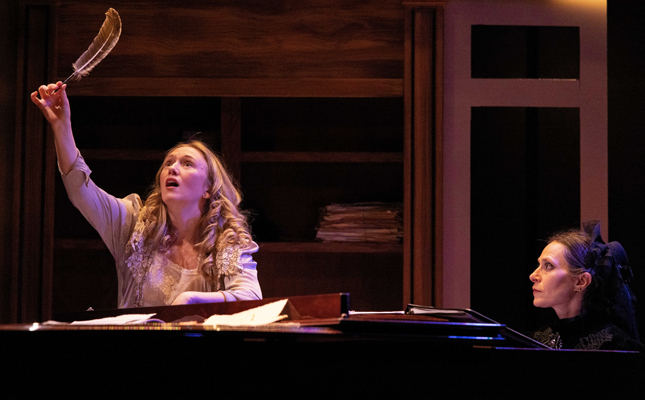
Dressed in elegant black, ‘invisible’ Muse (Melody Fader) assumes her position at a grand piano. The excellent musician intermittently performs throughout . A galvanized Fanny Mendelssohn (Annalisa Chamberlin) scribbles on manuscript atop the piano and then hears passages in her head – which are played aloud.
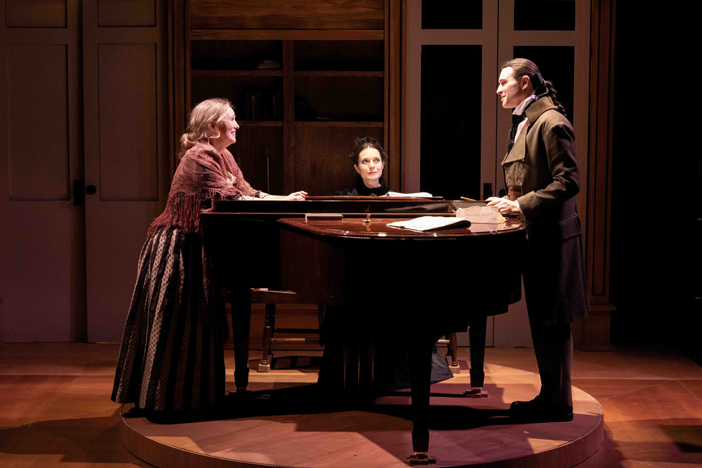
Annalisa Chamberlin (Fanny Mendelssohn ), Melody Fader (Muse), Zaq Latino (Felix Mendelssohn)
Educated with her brother Felix, Fanny is a prolific composer of songs, piano pieces, and chamber music. He, as a man, has his music published, while she’s refused because of her sex. Exasperated, she plays her own compositions only at home salons. Felix admires her talent. They critique one another’s work, but ultimately her sibling’s feelings reflect the times.
As the career of a musician is denied, Fanny’s parents, Abraham (Rufus Collins- apt gravitas) and Lea (Una Clancy-credibly protective) encourage her to marry and start a family. She’s not against this, but prioritizes music and is aware most men won’t respect her pursuits.
Two suitors come calling, so welded at the hip, Fanny inquires as to whether they’re married. Business-like Landsatraker (Adam LaSalle) and sleezy Lamonde (Kelsey McClarnon) are primarily drawn to the Mendelssohn money and status. She summarily sends them packing.
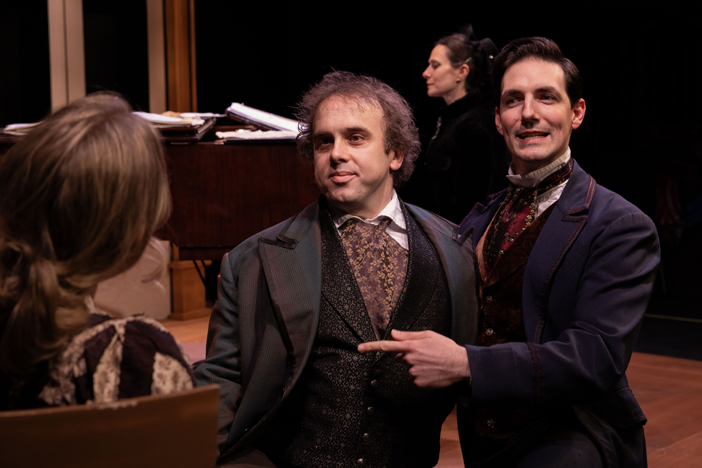
Fanny, Kelsey McClarnon (Lamonde), Muse, Adam LaSalle (Landstreiker)
The heroine’s heart belongs to struggling artist, Wilhelm Hensel (Daniel David Stewart- an appealing character created by this actor in whole cloth.) Hensel returns from Italy regaling Fanny with poetic impressions. Enthusiasms mesh. It’s she who kisses him. Because he’s poor, her parents attempt to dissuade Fanny-but not very hard.
Also in the household are little sister Becka (Ava Delaney- a better vocalist than actress- the play contains a single song.) And family friend, poet, Heinrich Heine (Mark Shock- vividly present.)
The Mendelssohn family converted from Judaism for social reasons and to secure greater opportunities for the children. There was some Prussian prejudice, but Abraham’s position as co-founder of a banking firm for the most part sheltered them. Here, the situation balloons into threat, implying rather than illuminating the situation. Mendelssohn Sr. helped his fellow Jews, but the appearance of a “revolutionary” and his daughters’ innocent attempts to help are never clarified.
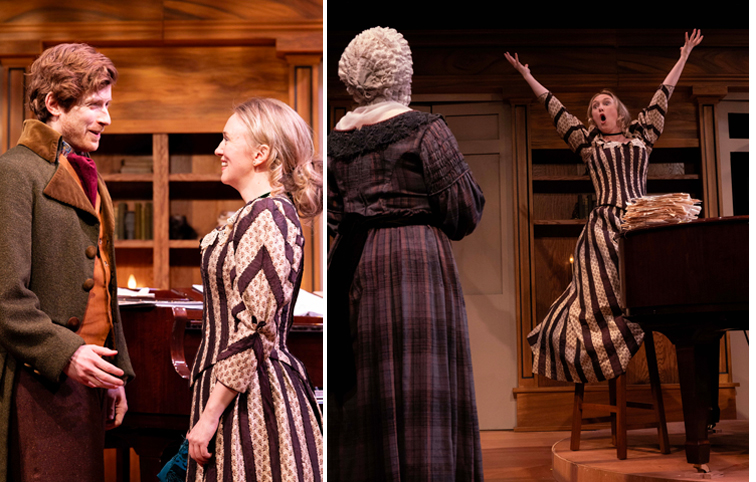
Daniel David Stewart (Wilhelm Hensel) & Annalisa Chamberlin (Fanny); Una Clancy (Lea Mendelssohn) &
Annalisa Chamberlin (Fanny)
The scene is thus set for Fanny’s life. An 18 year marriage to supportive Hensel (one son), her siblings’ marriages, and Felix’s rising fame are historically accurate. A longed-for trip to Italy chronicled by her diaries is exemplified by a colorful carnival exhibiting social mores foreign to the visiting Germans. The scene is artfully staged. Fanny and Hensel both flirt, she with composer Charles Gounod (Alan Kelly- buoyant), he with an art student.
Lemonde never gets over Fanny’s early rejection and exacts horrible revenge. There are consequences, but severe damage is perpetrated, a gripping denouement. Abraham and Lea pass, as eventually does Fanny. Ghosts subtly hover. The ending is extremely evocative.
With research, I was surprised to learn how much of the plot is made-up. Fanny lead a less eventful life. Lamonde didn’t exist. As a married woman, the heroine played a central role in Berlin’s musical life. In her final year, she began publishing music under her own name, gaining long overdue recognition before her death at 41. Nonetheless, playwright Tim McGillicuddy concocts an entertaining tale with many captivating characters, lush music, and a feel for the epoch. Some editing would be welcome.
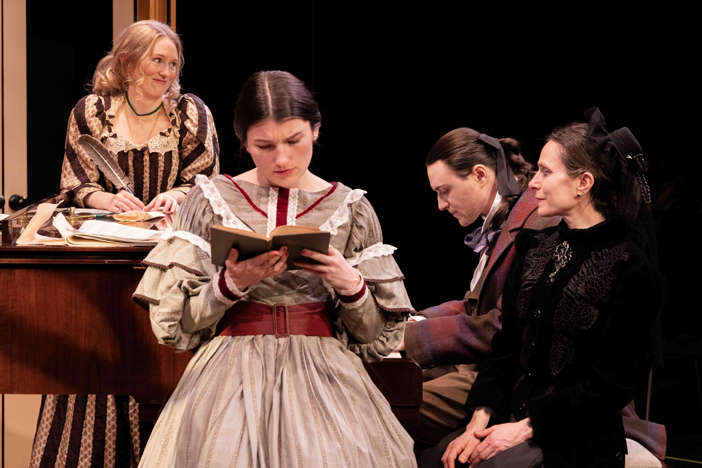
Annalisa Chamberlin (Fanny), Ava Delaney (Becka Mendelssohn), Zaq Latino (Felix Mendelssohn),
Melody Fader (Muse)
Featured music is well chosen, blended, engaging, and excellently performed. It includes that of Mendelssohn, but also Bach, Mozart, Schubert, Chopin, Verdi, and Pieczonka. Occasional dialogue inquires are literally answered with music. Fanny or Felix’s briefly playing beside the Muse work beautifully.
Director George Abud offers the marvelous conceit of his Muse at a piano on a turntable. Dialogue pacing is natural. Character ‘arrangements’ are painterly. Caveats: Audience on two sides too often stare at the back of an actor for protracted time, blocking views of another who’s speaking. There’s no credit for fight direction. While falls are good, punches/scuffle is not.
Fanny’s moods are extravagantly expressed- theatrically laying upside-down on a chair, chasing Hensel around the piano, shouting. She’s clever with people, naïve about politics, and emotionally clear about what she wants. Actress Annalisa Chamberlin embodies the heroine as something of a wild child- theatrical, expressive, headstrong. Though accounts and records suggest Fanny was intelligent and disciplined-calmer, the character emerges captivatingly real. (A little less loud, perhaps.)
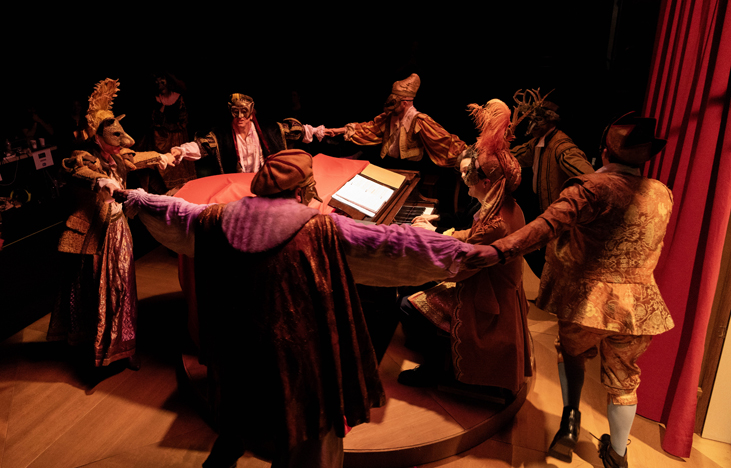
Carnival
Tonight Mark Shock steps in as family friend/poet Heinrich Heine without dropping a stitch. Acting is nuanced and sympathetic throughout.
Una Clancy’s brief portrayal of a gypsy is splendid.
Scenic Design (Henry Pederson) is a practical, period, back wall with shelves and alas, flimsy doors.
Costumes by Raul Luna are worthy of any Broadway play- flattering, fitted, period correct, varied, and aesthetic together onstage
Photos by Chase Randall
Opening: Annalisa Chamberlin (Fanny); Melody Fader (Muse)
Off-Brand Opera presents
Fanny- A Fantasy in G – a play with live music
Written by Tim McGillicuddy
Directed by George Abud
Through April 12 at The Gural Theatre at A.R.T./New York 502 West 53rd Street
April 15-19 at the Liederkranz Club 6 East 87th Street