
Review by Ron Fassler . . .
Jesse Tyler Ferguson, a television star with deep roots in the theatre (and a Tony Award to show for it), is onstage in New York once again for a limited engagement in Tru, Jay Presson Allen’s one-person play about Truman Capote. Dead 41 years now, Capote was once a successful novelist, screenwriter, playwright, poet, and lyricist—a household name, even. Worldwide acclaim for his self-described “non-fiction novel,” In Cold Blood (1966) secured him a place as one of the progenitors of “new journalism,” alongside Norman Mailer and Tom Wolfe. His acerbic, quick wit seemed on constant display on television; everything from The Tonight Show with Johnny Carson to The Sonny & Cher Comedy Hour. Capote unvarnished, uninhibited, and sometimes unhinged, frequently turned these appearances into visual essays of desperation and anxiety, leaving viewers to wonder if he’d get home safely from the studio without assistance.
Such a character does set the stage for a potentially captivating evening, which it certainly was in its original production back in 1989, just five years after the author’s death at fifty-nine. Starring a then-fifty-eight-year-old Robert Morse, known primarily as the pint-sized star of the stage and screen versions of the musical comedy How to Succeed in Business Without Really Trying, it served as a rousing comeback for a one-of-a-kind talent who had essentially been put out to pasture. It didn’t help that during those lean years Morse was an alcoholic, which he was public about. Clean and sober and back at the top with Tru, he won a much-deserved Tony Award. His reviews were unanimous in their praise of how he buried himself into the character of Capote, practically unrecognizable under a wig and fake jowls.
As someone who’s been going to the theatre steadily for close to sixty years, my head is stuffed with vibrant memories of original productions that can’t help but inform how I perceive revivals. No mere imitation, Morse’s portrayal of Capote, though done with the aid of gifted hair and makeup people, was predominantly an inside job. Using his own personal pain of being shunned and unrecognized to create something emotionally devastating, Morse was unforgettable.
Ferguson, who lacks little resemblance to Capote, doesn’t attempt anything with makeup or hair, which is commendable. At six inches taller, he’s the same size as Philip Seymour Hoffman—magnificent in the 2005 film Capote—where it wasn’t an issue either. What’s called for are the depths of feeling to which any actor must go to find the soul of the man, especially in this play, which takes place at what would mark the darkest time in his life and, essentially, the beginning of the end for him (he’d be dead nine years later).
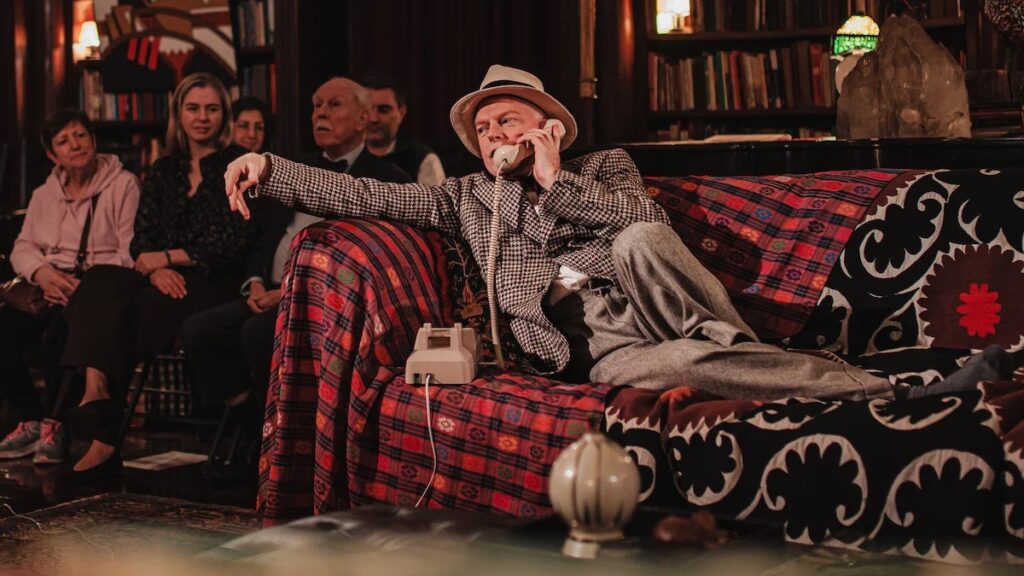
Capote’s manifesto, Answered Prayers, was intended as an exposé on New York high society to which he was drawn and, in most cases, welcomed. But when “La Côte Basque,” one of its chapters, was published in advance in Esquire, the women he thinly disguised—and whose confidences he betrayed—dropped him cold. Not used to being on the outside of things with his nose pressed to the glass, Capote was never the same. Published in November 1975, Tru takes place over Christmas a month later in his East Side apartment, where gifts from Tiffanys still need to be wrapped and delivered, even if they may never be acknowledged. Famously, he never finished his novel.
But this gives an actor the chance to bitterly crack wise, snort cocaine, drink loads of alcohol, smoke cigarettes and complain, complain, complain. Allen’s script has loads of one-liners and allows us to share in Capote’s memories of growing up in the Deep South, poor, practically orphaned, and gay. It’s not uninteresting territory. And Ferguson is a pleasant guide. But where’s the rage? Where’s the range? Ferguson possesses the bag of tricks necessary to take the character into funny territory, but not a more dangerous one. With Morse there seemed to be a palpable need to tell the story that’s seriously missing from this production. Ferguson entertains, but he doesn’t captivate. Perhaps there’s a limit to what he can do due to the staging at the House of the Redeemer, an unorthodox space in a 110-year-old Upper East Side townhouse. With an assist from scenic designer Mike Harrison, its library is not so much transformed into a theatre space, as adjusted. With seating for 99 people, the oblong room is beautiful with floor to ceiling bookcases (well, not the ceiling, which reaches up into the stratosphere). Surprisingly, Ferguson does not wear a wireless mic, testimony to his vocal prowess—and the acoustics—leaving no amplification necessary while he roams the room.
Ferguson is joined in what was once a one-person play by the actress-dancer Charlotte D’Amboise. She is the first thing we see, garbed like a refugee from the original cast of Follies, breathtakingly beautiful in a stunning, backless, black and white gown designed by Sam Spector (not coincidentally to conjure images of Capote’s famed Black & White Ball, which he hosted at the Plaza Hotel, conclusively defining the pinnacle of 1960s high society). D’Amboise, proudly poised, moves gracefully throughout much of the play, speaking a few of the women’s voices heretofore pre-recorded in prior productions, adding an elegant touch. Meant to represent one of the “swans,” the name Capote gave to Slim Keith, Babe Paley, and those other women in whose orbit he swirled for a time, D’Amboise is elegance personified. This is Rob Ashford’s major contribution as director and both in concept and execution it comes off appropriately theatrical and a welcome device.
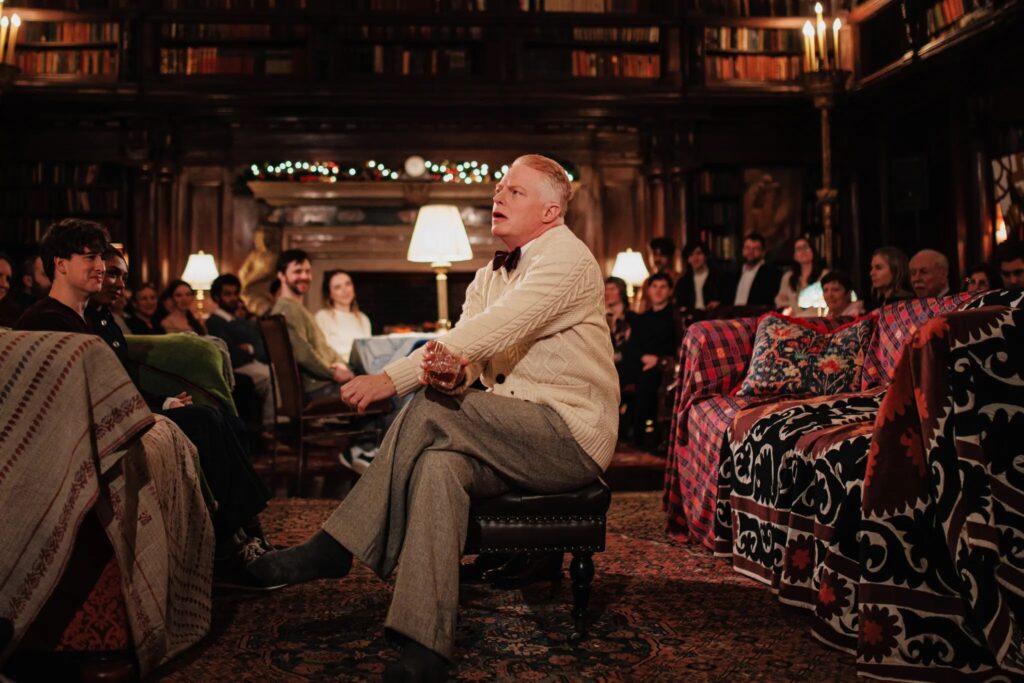
Recommending Tru is a no-brainer; it’s fun, funny and well done. The space is unique and Jesse Tyler Ferguson is charming, even if one wishes for someone in the role with a genuine score to settle. With so much success over the last twenty years, what Ferguson is attempting reminds me of a time back in the 1990s when Angela Lansbury sang “Send in the Clowns” on a Tony Awards broadcast. At the viewing party I attended, a friend seated next to me leaned in quietly and said, “It’s tough to sing the blues when you’re making $100,000 an episode.”
Tru is playing a strictly limited engagement at The House of the Redeemer, 7 East 95th Street, NYC, now through May 3rd.
Photos by Mark J. Franklin.