By Alix Cohen
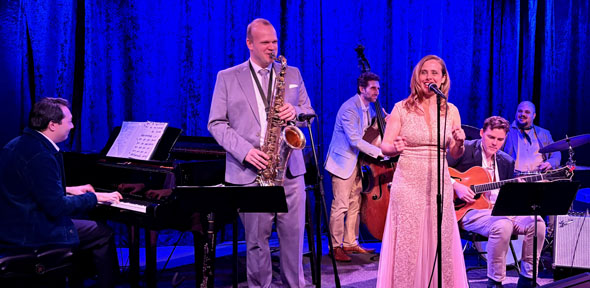
When Frenchwoman Margot Sergent appeared at the doors of Berklee School of Music 12 years ago, she had a classical harp background. When she left, the vocalist was a jazz baby. The latter persona is so authoritative, only Segent’s refinement reflects musical roots. Tonight I experience the pleasure of discovery.
“Cest Si Bon” (Henri Betti/André Hornez) arrives in a sax-centric arrangement. Sergent is flirty. Eyebrows rise and fall. Hands play the air like an instrument. Elbows bend, fingers shift; arms extend, fingers snap. Scat arrives with a little (Maurice) Chevalier growl.
Serge Gainsberg’s “La javanaise” refers to a slang sound symbolizing romantic transience and bittersweet joy. Strolling piano, hazy brushes, and tantalizing bass create reverie. “Whether you admit it or not/As we danced the Javanaise,/ We loved each other/For the time of one song.” If we’d only heard at least that verse in English. Heartsore scat climbs, slides, somersaults. The artist’s scat is a personal language.
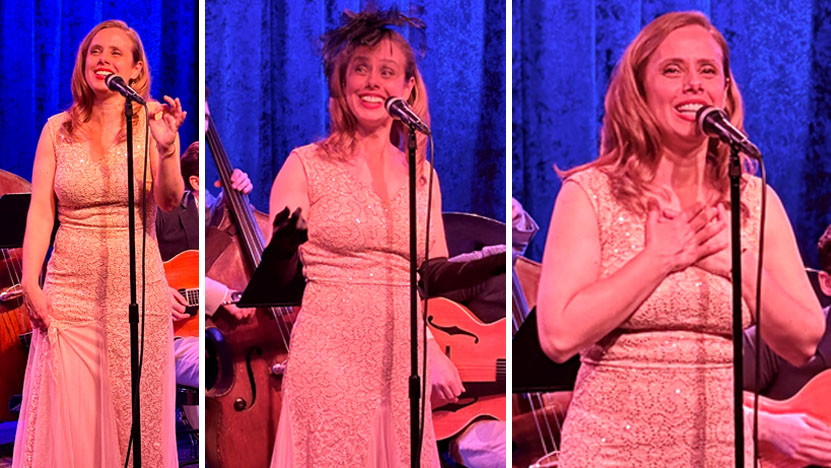
“Cheek to Cheek” (Irving Berlin), first in French, is discretely sophisticated. Poised, Sergent turns slightly taking us all in. “Heaven…” she nods and smiles…”I can hardly speak…” hands cross across her breast. The song emerges head-bobbing, light swing. Her voice is silken.
“Jardin d’hiver” (Benjamin Biolay) is an intimate, nostalgic song yearning for warmth, love, and simple pleasures amidst a cold, gray season. The vocalist’s knitted brow communicates mood. Shadowy bass, later bowed, yields to low clarinet which contributes a skeletal, wintry sound.
“I would like some green sun/Some lace and teapots/Some photos of the Seaside/In my winter garden…” Phrasing is dramatic. Sergent inhabits lyrics, but bruised poetry is hidden by lack of comprehension. The arrangement is beautiful, vocal crystalline.
This is a show, we’re told, that will expose us to and perhaps disabuse us of a soupçon of French culture. Sergent shares the true meaning of conscripted words, “rendezvous” and “ooh la la,” which are sexualized in English. Later, “The best of French culture is a necessity to question sureties” leaves us hanging.
“Sometimes the French have a sense of humor.” Donning a black fascinator and opera gloves, the vocalist performs a winking “Sympathique.” (Thomas M. Lauderdale/China Forbes)
Its chorus, in English, indolently declares, “I don’t want to work, I don’t want to have breakfast, I only want to forget and then I smoke.” Jazz guitar evokes Django Reinhardt. Clarinet is sassy. Vocal attitude is wry. Still, I can’t help but wonder how many in the audience understand.
These next songs describe phases of love. The first is short and lovely, the second breaks your heart, the third manifests long lasting companionship (paraphrased)
“Plus Je T’embrasse” (Blossom Dearie) swings in light and comfortable. “The more I kiss you/The more I want to kiss you again…” Guitar pulses with melodic vertebrae. Bass’s slip/stream phrasing is rapt. A well calibrated vocal sings happy.
“La Vie en Rose” (Louis Guglielmi/Edith Piaf) idiomatically means seeing life through rose-colored glasses. The familiar song, in French and English, begins as a stage whisper. Hands clasped, Sergent exudes warmth, not theatrics. Clarinet and vocal promenade. Scat is delicate. Fading with the sshh sound of a beating heart, emotion hovers.
There’s a full moon tonight at 5:09,” introduces “Moon River” (Henry Mancini- French version Margot Sergent) A classical piano preface morphs into the familiar tune. Bass and percussion are cottony, brushes swish. Sergent is radiant.
The band is excellent and symbiotic.
Caveats: The show is a bit too long. Disjointed patter can successfully be edited. Too many songs are solely in French. Though performance is marvelous, we’re kept from relating without context.
Photos by Stephen Hanks
Jazz Chanson– Margot Sergent
Peter Yarin- Piano, Linus Wyrsch- Clarinet, Sax, Alec Safy-Bass, Ben Silashi- Drums
Birdland 315 West 44th Street https://www.birdlandjazz.com/