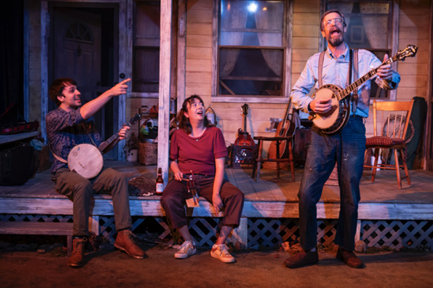
A New Play with Old Music- Returning to Urban Stages January 25- February 22, 2026
By Alix Cohen
Mira (Tora Nogami Alexander), a biracial, Korean American, classical violinist, and her boyfriend Beckett (Morgan Morse) are in South Carolina on a trip to visit hootenannies as research for his graduate thesis. Beckett/Beck boyishly erupts with intriguing history throughout the play.
When their camper has issues, the couple look for a closer music fest than the one originally intended. Beck reads off town names. Windy Hill rings a bell. Mira spent her childhood there, but hasn’t been back in 18 years. At the Hoot, they encounter her estranged grandfather Edgar (David M. Lutkin).
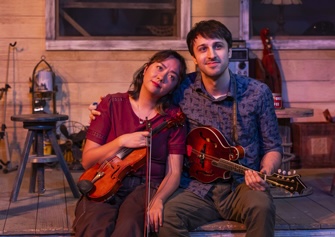
Tora Nogami Alexander and Morgan Morse
Things are awkward. Beck has no idea why. Nonetheless, the two accompany “Gar” as he prefers to be called, back to his house. The elder man and Beck connect playing “Columbus Stockade Blues,” Gar on banjo, Beck on mandolin. Both actors sing well and are superb on banjo and guitar; Morse additionally excels on mandolin, Lutkin on dulcimer.
Granddad, now a widower, is a purist and curmudgeon. He disparages the term ‘hootenanny’ as originating with “a bunch of hippies sittin’ around the city playin’ “Michael Row the Boat Ashore.” The correct term is “picking party.” Computer and cell phone are absent. As written and acted, the character feels genuine.
Mira is encouraged to join the men on her violin. (Later, she plays a Chinese stringed instrument called erhu. The actress also has a fine voice.) Despite a large chip on her shoulder, she can’t resist. It turns out there were musicians around her childhood who who are now famous. In those days, she played fiddle, not violin and adored Gar.
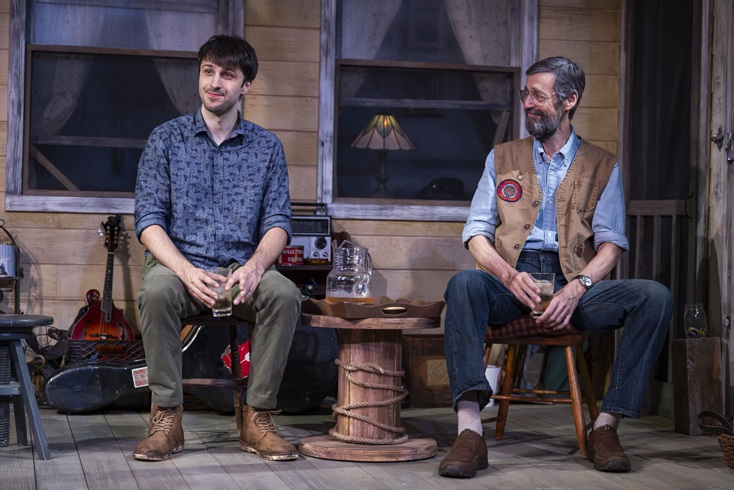
Morgan Morse and David M. Lutkin
The three sing and play “Old John Carson.” Gar is pleased and surprised. Mira has surprised herself. Inklings of the past emerge. “Why haven’t you talked about or seen your grandfather?” Beck asks. Herein lays the play.
Like peeling an onion, raw, shared history reveals itself skin by skin. Old prejudices are unearthed. What was intended as protection proved to alienate. Both Mira’s parents and grandparents were stubborn making reconciliation impossible. As day turns to night, then again day, the three make music, sing, eat, drink moonshine and are finally honest with one another. “After the music stops, we still have to do the work.” (Sherry Stregack Lutkin)
Details about music, food, and local attitudes are realistic. Characters and relationships emerge whole. Changes occur slowly. Sherry Stregack Lutkin tells me the piece was co-written during the Pandemic. That four artists contributed, yet Windy Hill remains cohesive, is a small miracle. Music, she tells me, is 14th to 16th century folk, but sounds familiar.
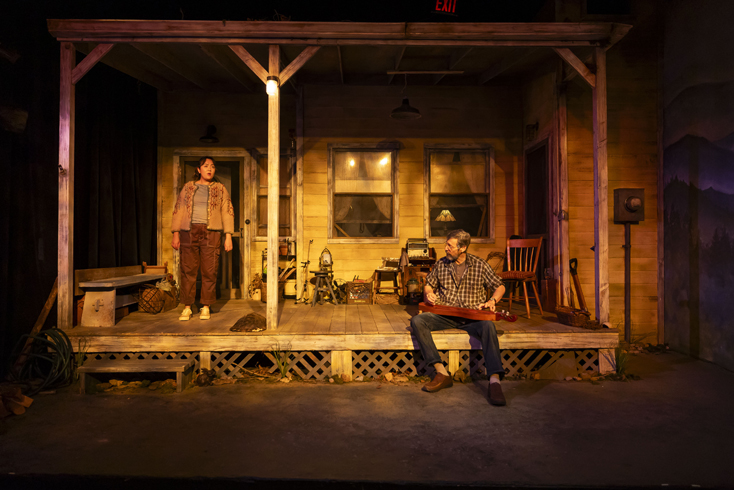
Tora Nogami Alexander and David M. Lutkin
Acting and musicianship are excellent. Tora Nogami Alexander is palpably torn. We learn how the past influences her present without being told. Morgan Morse embodies a sympathetic, frustrated Beck. David M. Lutkin, though a bit too young to be grandpa, inhabits Gar’s idiosyncrasies, laconic style, and moves with a tad of stiffness. We end up believing.
Direction aesthetically uses the stage and aisles. Small business works. Pacing is adroit. (Sherry Stregack Lutkin)
Orchestrations/Arrangements of classic Appalachian and Bluegrass songs are skillful, entertaining, and authentic. (David M. Lutkin)
Andrew Robinson’s Scenic Design is apt and evocative, though some of the brushed, black dirt is too evenly spread.
Eliza Kelley’s props add a great deal.
Costumes by Grace Jeon are just right
Photography: Ben Hilder
Opening: Morgan Morse, Tora Nogami Alexander and David M. Lutkin
The Porch on Windy Hill- a new play with old music
Conceived and Directed by Sherry Stregack Lutkin
By Sherry Stregack Lutkin, David M. Lutkin, Lisa Helmi Johanson, and Morgan MorseUrban Stages Theater 259 West 30th St., NYC.
Running time: 2 hours and 10 mins with a 15 min intermission. urbanstages.org
January 22- February 22, 2026