“If music be the food of love play on.” Orsino, Twelfth Night
By Alix Cohen
In August 1956, Duke Ellington and Billy Strayhorn were performing in Canada when they crossed paths with the Stratford Shakespearean Festival. The encounter lit a creative fuse: Ellington announced that their next major project would be a musical tribute to Shakespeare’s characters, themes, and language.
Composed and recorded between August 1956 and May 1957, each of 12 movements responds to a specific Shakespeare play or figure filtered through Ellington’s orchestral palette and Strayhorn’s harmonic imagination. The album was immediately recognized as a landmark: a modernist, literary infused jazz suite.

Miles Puriton (Host/Puck
The collaborators believed that jazz could stand shoulder to shoulder with classical forms—programmatic, narrative, and culturally ambitious. It’s a testament to their shared love of Shakespeare’s psychological nuance, which is translated into character driven musical portraits.
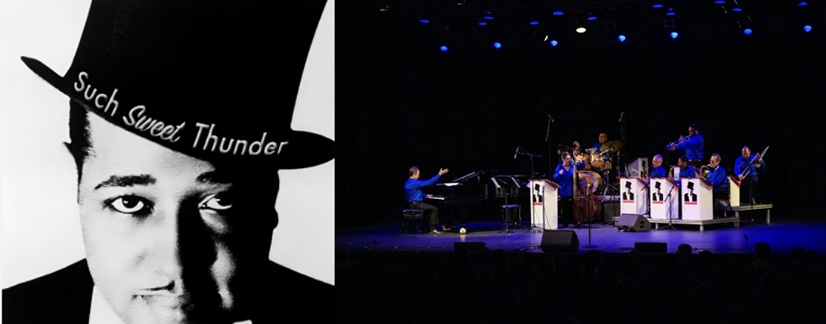
The Duke Ellington Center for the Arts in collaboration with the American Tap Dance Foundation adds play synopsis, spoken Shakespeare, dance, and songs with original lyrics to create an evening of multi-art entertainment. The original piece was conceived solely as music. Cast is drawn from former and current professionals in the community.
Such Sweet Thunder – Source: A Midsummer Night’s Dream -Regal fanfare meets puckish swing. A broad overture captures Shakespeare’s blend of majesty and mischief. The title comes from Hippolyta’s line about the hunt. Company members in black and masks pose and freeze as the orchestra plays. A mellow sax gives way to evocative trumpets with mutes.
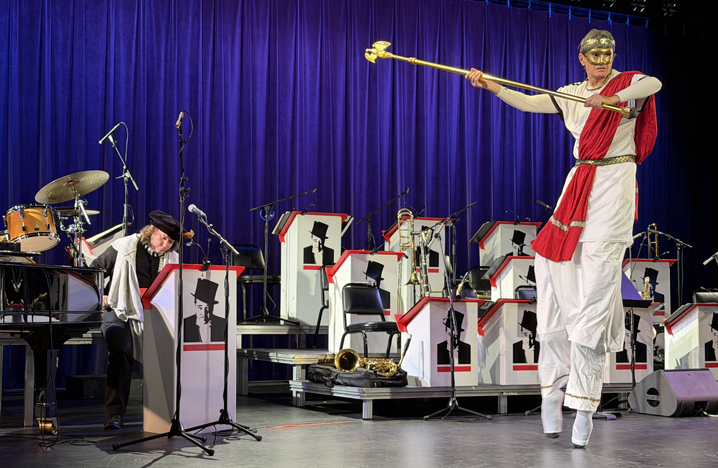
Mark Mindek on stilts
Sonnet for Caesar -Source: Julius Caesar – Slow, ominous, processional. A portrait of Caesar’s gravitas and the inevitability of his downfall. Trombones carry the weight of empire. Clarinet adds imperial color. Music is ominous, roiled. On stilts, a striking Mark Mindek confidently stalks.
Sonnet to Hank Cinq – Source: Henry V– Brassy, martial, swaggering. A cheeky, modernized king is charismatic. Three of Shakespeare’s plays feature Henry. Trombone leads a swing number. A.C. Lincoln tap dances on wood platform and the stage floor. Dance is self-assured, tight.
Lady Mac– Source: Macbeth .“Though she’s a lady of noble birth,” Ellington said, “We suspect there was a little ragtime in her soul.” Seductive, sharp, dangerous. Lady Macbeth’s ambition and volatility. Alto sax cuts like a dagger. Karen Callaway Williams and DeWitt Fleming Jr. as Lady Macbeth and Macbeth execute stylish tap. Four Witches in blue sequined minis are former Rockettes: Karen Tomczak, Mary Lilygren-Kane, Stephanie Bishop, Vanessa Gutierrez-McMahan
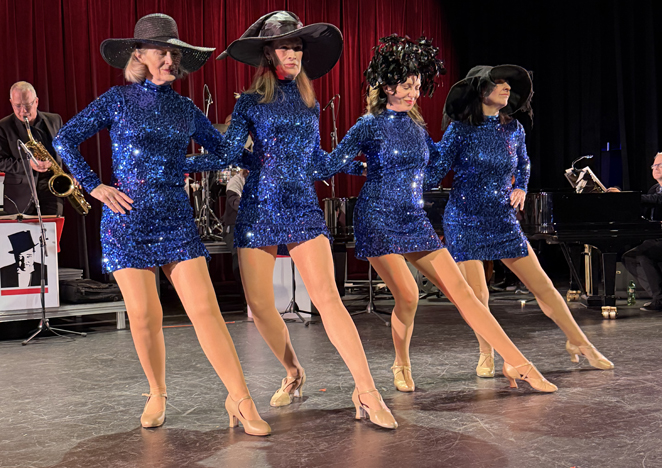
Vanessa Gutierrez-McMahan, Stephanie Bishop , Mary Lilygren-Kane , Karyn Tomczak,
Sonnet in Search of a Moor– “but also amour”, narrator, Miles Purinton tells us. Source: Othello – Lush, yearning, harmonically rich. Strayhorn’s fingerprints are strong here — a searching, melancholic meditation on Othello’s nobility and vulnerability. Marion Cowlings sings Othello with his own original lyrics.
Sonnet for Sister Kate– Source: The Taming of the Shrew – ‘Bold, assertive, blues inflected. A portrait of Kate’s fire and independence, not her “taming.” Authoritative trombone flares. Vocalist Antoinette Montague sings her original lyrics: “…with my progressive attitude, I don’t have many friends.”
The Star Crossed Lovers – Source: Romeo and Juliet– Ellington’s summation, “This is the sad story of two beautiful people.” ‘Tender, lyrical, restrained. One of the suite’s most famous movements — a saxophone duet captures doomed intimacy without melodrama. The pas de deux by Ema Nohalova and Michael Choi is an evening highlight.
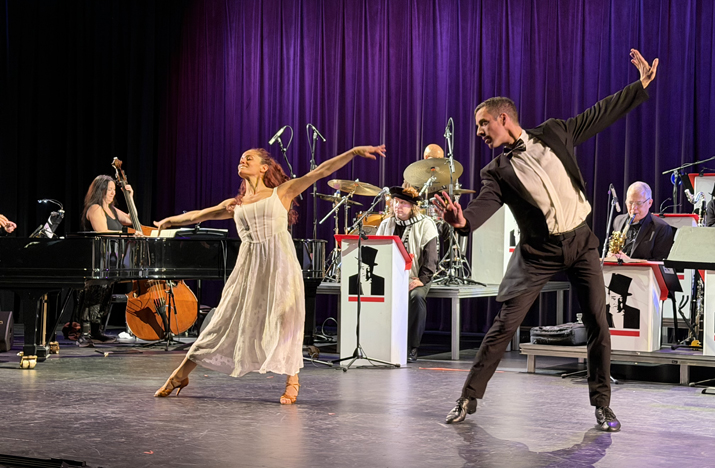
Danae Avloniti & Milos Jadzic
Madness in Great Ones – Source: Hamlet– Explosive, fragmented, unstable. Hamlet’s antic disposition rendered as musical volatility — sudden shifts, bursts of brass, psychological fracture. “Madness in great ones must not unwatch’d go.” Trumpet excels. Body percussionist Max Pollak expresses Hamlet’s madness with theatrical vigor and unexpected characterization. ‘Another highlight.
Half the Fun – Source” Antony and Cleopatra – Exotic, sultry, atmospheric. A Cleopatra portrait through Ellington’s 1950s lens- sensual, mysterious. Lush saxophone. Looking like a Follies girl, the queen enters in procession and dances with Mark Antony:
Circle of Fourths – Source: Encompassing tragedy, comedy, history, sonnets. The section is built on harmonic patterns, rather than character. Tenor saxophones rule.
Up and Down, Up and Down – Source: A Midsummer Night’s Dream – “I will lead them up and down”- Puck. Playful, mercurial, rhythmically slippery. Fairy royalty Tatiana and Oberon (Jennifer Murmylo and Rafal Pustelny) ballroom dance. Two couples expertly jitterbug. Music sounds like everyone speaking at once. “Lord, what fools these mortals be!” Puck.
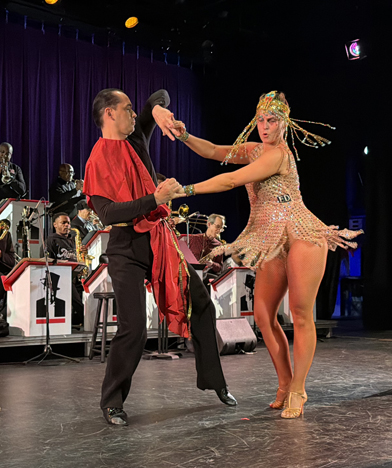
Ema Nohalova & Michael Choi
Missing from the Suite is Telecasters – Source: Much Ado About Nothing
The Duke Ellington Center Big Band is top notch, the piece itself a revelation. Collective appreciation pervades. Attention dance companies, this would make a spectacular evening! Here, there’s a bit too much happening onstage distracting from actual music. More faith in an audience that will listen would serve. Production runs smooth.
Photography by Tony Waag
Duke Ellington’s Such Sweet Thunder
Produced by The Duke Ellington Center for the Arts , Founding Artistic Director Mercedes Ellington in collaboration with the American Tap Dance Foundation, Founding Artistic Director Tony Waag Featuring The Duke Ellington Big Band under the musical direction of Eli Yamin
Narrative by Miles Purinton
The Duke Ellington Center for the Arts 211 Duke Ellington Boulevard https://www.decfa.org/
Symphony Space 2537 Broadway at 95th Street https://www.symphonyspace.org/
December 12, 2025